

AI Max Only Works If Your SEO & GEO Have Done the Work
Google’s AI Max is coming to Shopping. Success won’t just depend on your campaigns. It will increasingly be driven by the quality of your PDPs and product feed.

Google’s AI Max Is Coming to Shopping
Success won’t just depend on your campaigns. It will increasingly be driven by the quality of your PDPs and product feed.
AI Max for Shopping is coming. After a year on Search campaigns, Shopping is the next surface Google has announced for AI Max. It’s not live yet, but Google’s trajectory is increasingly clear.
This isn’t simply another automated feature. It’s a shift in how performance gets generated, and the gap will widen for brands still treating feeds and PDPs as passive.
In reality, campaign structure and management still matter, but the main driver behind AI Max performance will increasingly be the strength of your PDPs and product feed.
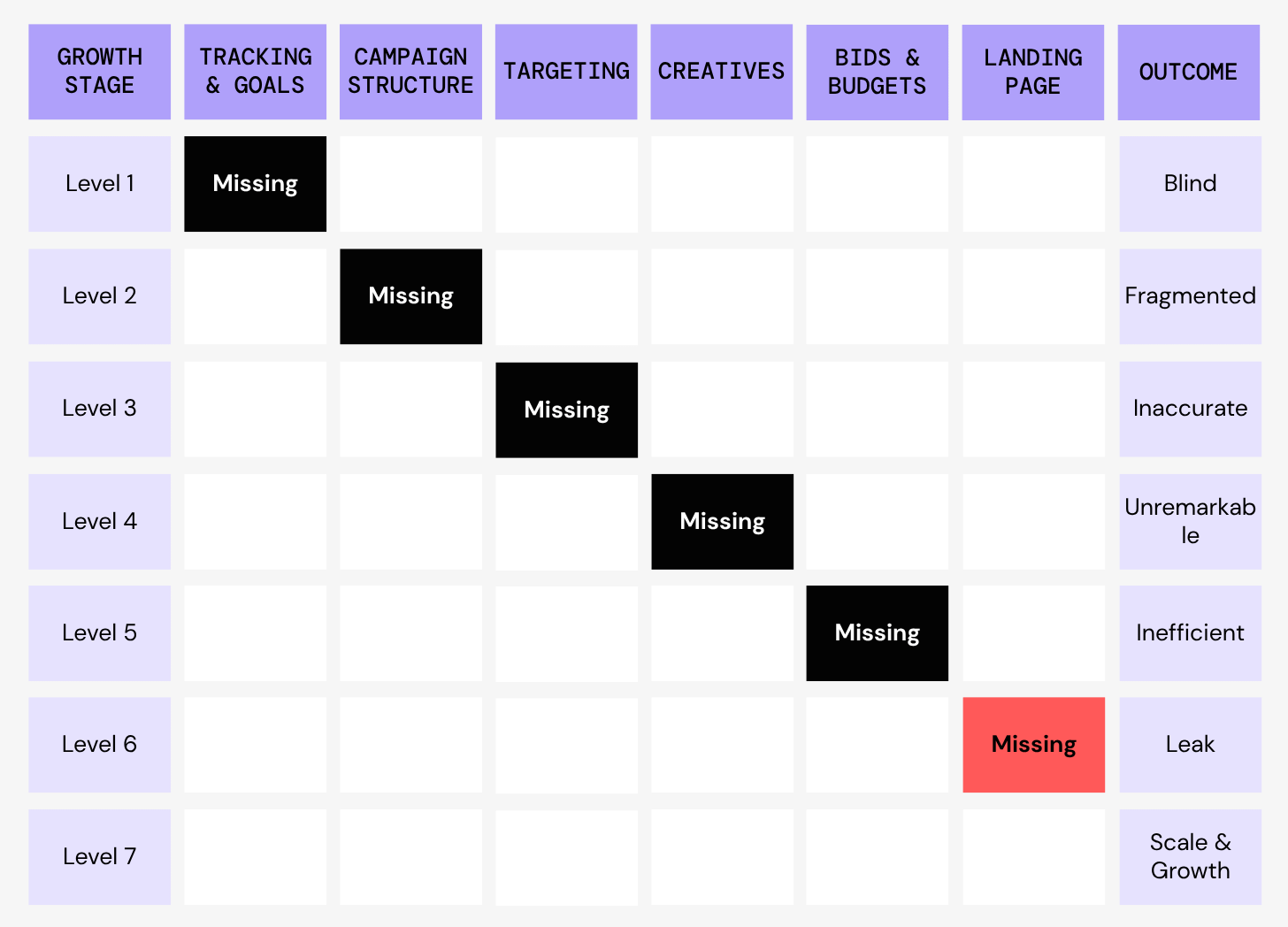
A useful matrix I use to audit Google Ads accounts illustrates this clearly: if the landing pages are weak, the account won’t scale efficiently, and performance will leak. That becomes even more relevant with AI Max.
What AI Max Actually Does
For years, Shopping worked like this: Title = your keyword strategy. You didn’t bid on keywords, but your titles were your targeting. The title has been the single biggest lever in the feed.
That changes with AI Max. Three core features:
Text Customisation generates ad copy on the fly, pulling from your Merchant Center feed, your existing ads, and your landing pages. You’re providing the raw material. Google writes the ad.
Final URL Expansion chooses the best landing page for a query, even if that’s not the URL you set. If your training guide is a better fit than the generic product page, Google routes traffic there.
Optimal Format Selection decides whether the query is best answered with a text ad, a Shopping listing, or both, and picks dynamically.
Translation: Google will no longer just read your feed. It will interpret it. Matching becomes semantic, not term-based. Every attribute, in the feed and on your site, becomes training data.
Why This Is an SEO, GEO and Product Feed Challenge
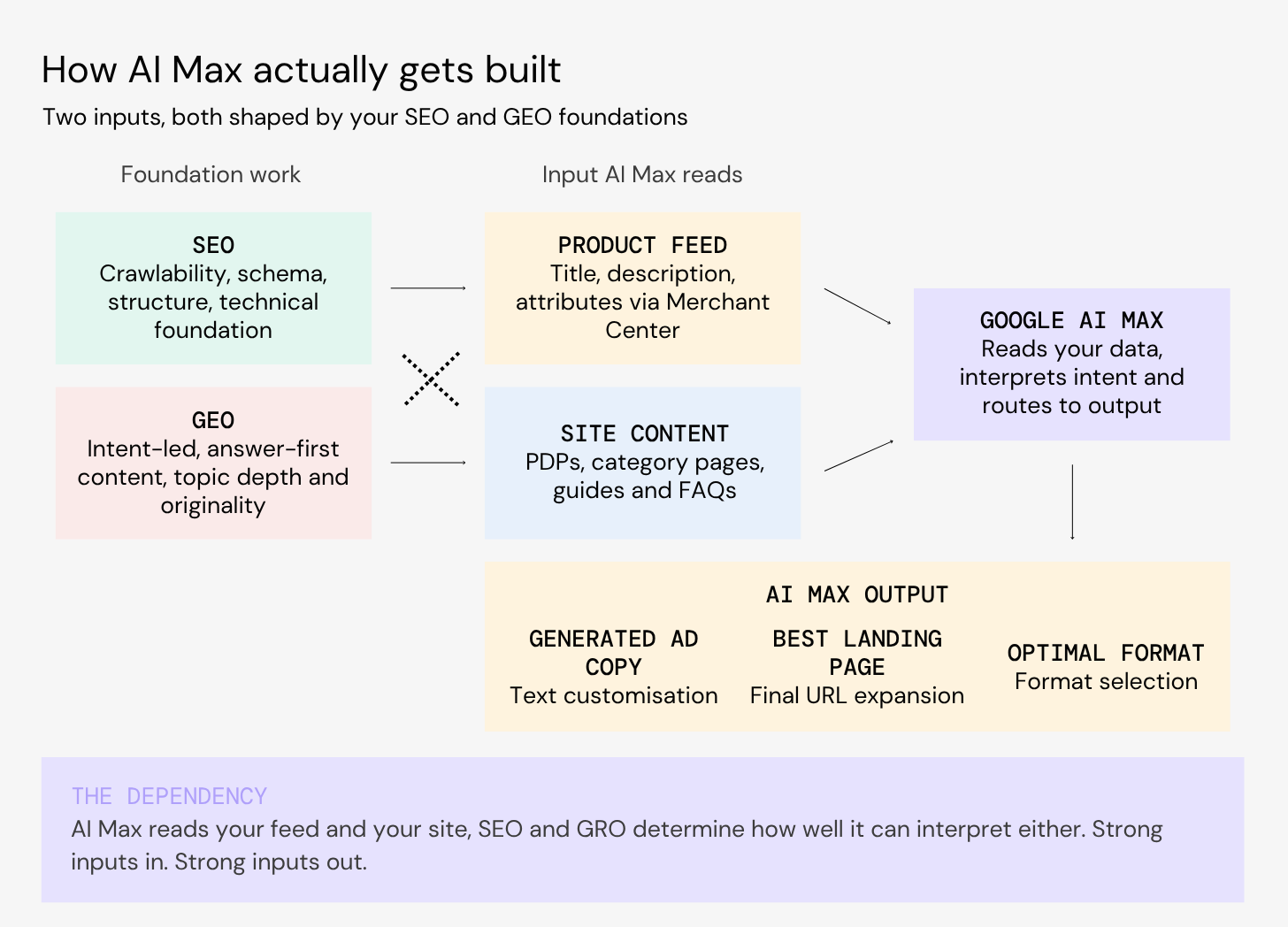
AI Max has two primary input sources: your Merchant Center feed and your site content. Each AI Max feature draws from one or both.
Final URL Expansion needs proper site architecture. It can only route between pages that it can crawl, understand, and rank. If your site has thin PDPs, weak category pages, or content trapped behind JavaScript, the “best landing page” Google picks will be the least bad one.
Text Customisation needs intent-rich content in both feed and site. Google generates ad copy by reading your Merchant Center attributes (title, description, product highlights, vertical-specific fields) and your landing pages. If your feed is sparse and your PDP is a pile of feature bullets and generic marketing prose, the AI has nothing useful to extract. It produces generic ads.
Optimal Format Selection needs alignment. When feed, page, and supporting content tell different stories, Google sees a fragmented product. Consistency is now an ad performance signal.
A note on GEO. It’s not a separate discipline competing with SEO. It’s an adaptation of SEO for how AI systems retrieve and rerank content. If you don’t have good SEO, you won’t have good GEO, because AI engines need a source to retrieve from. Many AI crawlers still can’t read JavaScript, so technical SEO is non-negotiable.
The same principles apply to AI Max. It’s a paid surface that consumes the outputs of your SEO, GEO and product feed work. Brands that have invested in those foundations will see AI Max amplify their work. Brands that haven’t will see it expose every weakness at the same time.
Where to Focus in the Feed
Title (still the strongest signal). Context-rich, not keyword-stuffed. Structure: Brand + Product Type + Key Attribute + Use Case + Variant.
Description (massively underused). Front-load use cases, problems solved, and differentiators in the first 160 characters. Cut the “premium quality” fluff.
product_type and google_product_category. Use the full taxonomy path, not just the top level.
Product highlights. 4 to 6 distinct benefit bullets.
Additional images. Lifestyle and detail shots, not just pack shots.
Vertical-specific attributes. Apparel: material, pattern, fit. Beauty: ingredients, skin type. Home: dimensions, room, style. These unlock long-tail queries you’d never bid on manually.
PDP alignment. Final URL Expansion only works if your pages answer: Who is this for? When should I use it? Why over alternatives? Add use cases, comparisons, and FAQs.
The Convergence Point Is the Page and the Feed
The feed and the landing page are no longer just paid concerns. They’re the convergence point of Paid, SEO, GEO, and CRO.
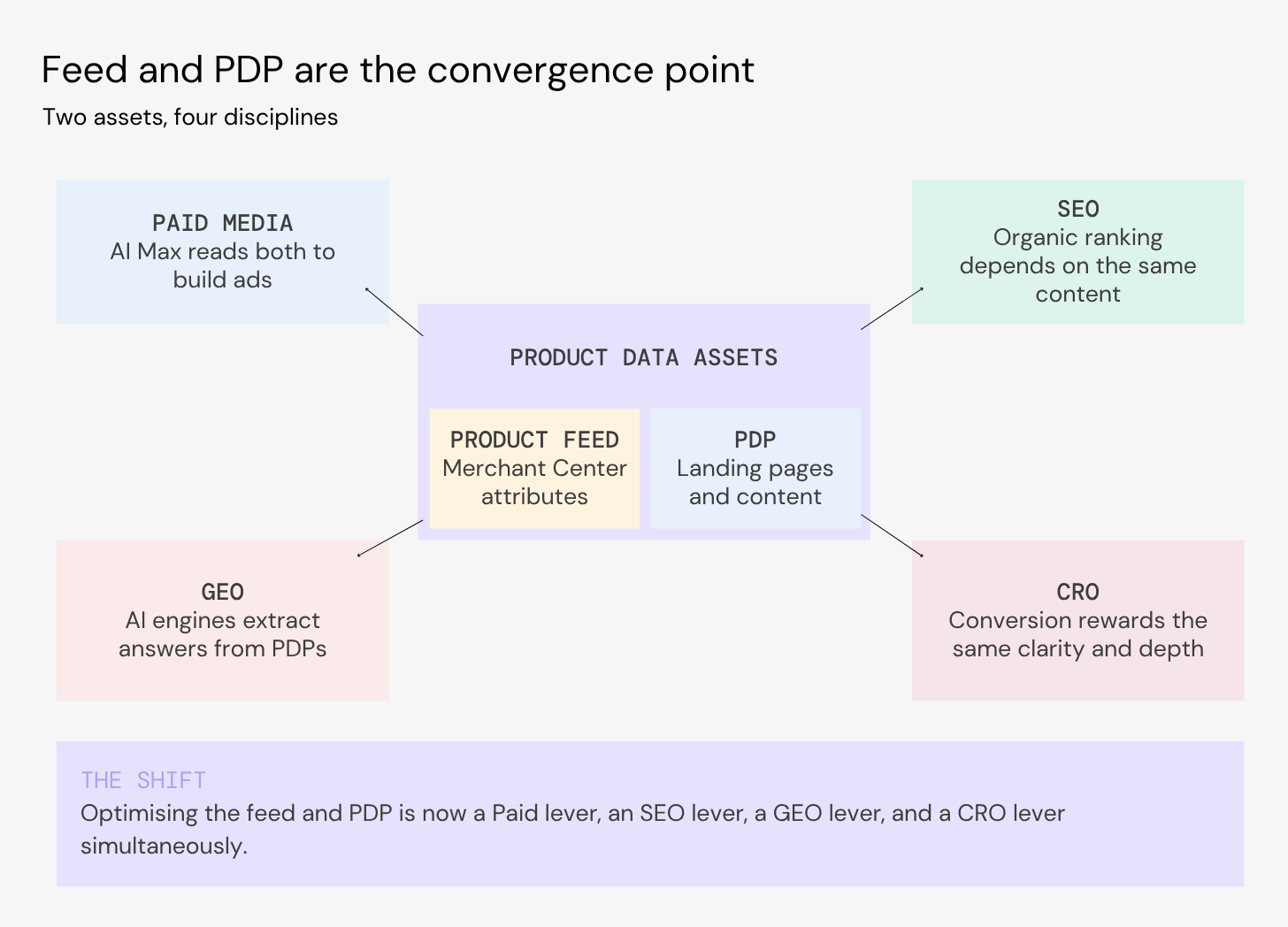
A modern PDP, and a modern feed entry, has to do several jobs at once: answer a specific intent, structure content for extraction, carry rich schema and attribute signals, align with each other, and demonstrate expertise. None of these are new individually. What’s new is that they’re all in the same brief.
The Org Problem
Most teams are structured around channels because that’s how budgets are allocated. There’s no single owner of product data and landing pages as a strategic asset. Yet feed quality, PDP content, structured data, and on-page relevance all feed the same system. Brands that get this working as one will pull ahead.
The Shift
Before: you optimised campaigns. With AI Max, you optimise the inputs into Google’s AI.
Most advertisers will switch this on, expecting performance gains. Reality: AI is only as good as the data you feed it.
AI Max success will not be decided by how well the Paid team optimises bids. It will mainly be influenced by how well the SEO, GEO and product feed foundations were built. The Paid team turning AI Max on is just the moment when that prior work becomes visible.
According to Google: “Advertisers that activate AI Max in Search campaigns will typically see 14% more conversions or conversion value at a similar CPA/ROAS.”
That 14% should be seen as an average baseline rather than a ceiling. Some brands have seen significantly stronger results with AI Max:
L’Oréal: +67% CTR, -31% CPA, and 2x CVR
Royal Canin: +263% conversions and -73% CPA
These uplifts are often driven by richer context, stronger product data, and better PDPs, all signals that were previously underutilised before AI Max.
What to Retain
Invest in your product data. Feed and PDPs are no longer hygiene tasks; they’re the foundation of future Shopping performance. Brands that treat product data as a strategic asset will get the maximum benefit from AI Max. Those who don’t will quietly fall behind.
Sources
https://blog.google/products/ads-commerce/ai-max-for-shopping/
https://support.google.com/google-ads/answer/15910366?hl=en-GB
https://business.google.com/uk/think/ai-excellence/loreal-ai-max-search-marketing-strategy/
https://business.google.com/uk/think/ai-excellence/how-brands-use-ai-max-search-campaigns/
 | A guest post by
|
The org problem you describe at the end is the one that kills most AI Max rollouts before they start — in practice, the feed is owned by the digital team, PDPs are owned by marketing, and structured data is owned by nobody. What we're seeing with larger retail accounts is that the brands getting real uplift from AI Max aren't necessarily those with the biggest budgets; they're the ones that did a feed-PDP alignment audit before flipping the switch, treating the product title, the description, and the on-page content as a single brief rather than three separate workstreams. The Royal Canin numbers (+263% conversions, -73% CPA) are extraordinary and worth unpacking — my hypothesis is that the pet food vertical has unusually high attribute density (breed, life stage, dietary needs) that creates very precise intent matching when Google interprets it semantically, which is a useful benchmark for other high-attribute verticals like beauty or home.