

Creative Is the New Targeting. Here's How to Build a System That Compounds.
The four-stage method to produce, test and learn from creative, continuously. It runs manually or fully automated.

A creative system sounds like a large, complicated build. It isn’t. Audit what you already do against the method below, and the blind spots get obvious: the places where your creative quietly leaks performance.
On Meta, and most creative-led channels, creative is now the lever. Delivery is AI-decided, so the auction reads intent from the creative itself, not the audience you pick. Your ad is your targeting. Building a system to produce, test and learn from creative isn’t just a nice-to-have; it is the job.
Most brands already run part of one. They plan, produce, test and report. The gap is rarely worth the effort. It is that the loop doesn’t close, and they can’t see where. The most common blind spot: insights get written into a monthly report or a QBR deck, and die there. They never reach the next batch of creative, so nothing compounds.
Now the practical challenge. No single product runs the whole loop yet. The platforms offer strong production tools (Meta Ads Manager, Google Asset Studio, TikTok’s suite), but they operate in silos, lacking shared memory or feedback into your next brief. Third-party tools connect more, but they cost money and rarely integrate cleanly. So you build the loop with tools, with custom systems, or a mix, to fit your budget. It runs manually, semi-automated or fully automated, and the method holds at every level.
This is the map. We walk it with live examples at our THRIVE Paid Media webinar on 15 July. Save your seat here: https://luma.com/orsd3ywm
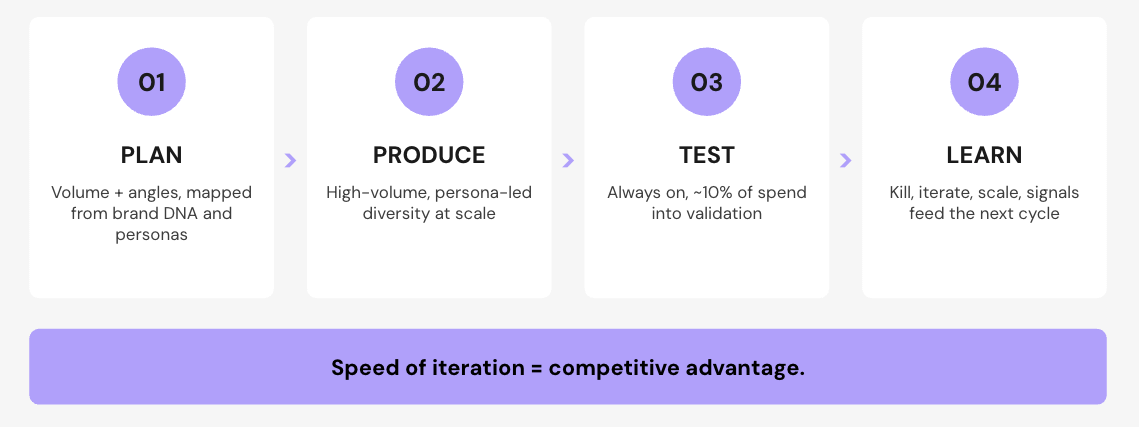
The four stages are Plan, Produce, Test, Learn. The point isn’t the boxes; it is that they feed each other: closing the loop is where the value lies. Volume alone won’t do it; the platforms read twenty headline-swaps as one ad and reward genuine diversity instead.
1. Plan
Without a plan, you can’t learn, because you can’t isolate what you tested.
The first question brands ask is how many new creatives they need a month. The honest answer is that it depends, and the best starting point is your current creative-led budget: the more you spend on channels like Meta, the more distinct creative you need to feed them.
You can read more on sizing creative volume in this piece:

From there, study what is already working in your market, then write a brief grounded in your brand and your personas.
Manual method: browse the Meta Ad Library, TikTok Creative Center and Google Ads Transparency Center, keep a swipe file, and write briefs from your brand and persona notes.
Tool-assisted method: platforms like Foreplay, Atria, Gethook and Kalodata speed up the research, and an AI assistant can draft briefs from your brand context.
Blind spot: a brief that is a vibe, not a testable hypothesis.
2. Produce
Diversity is the game, not the same ad twenty times. One ad with five headlines isn’t five ads; the algorithm reads it as one.
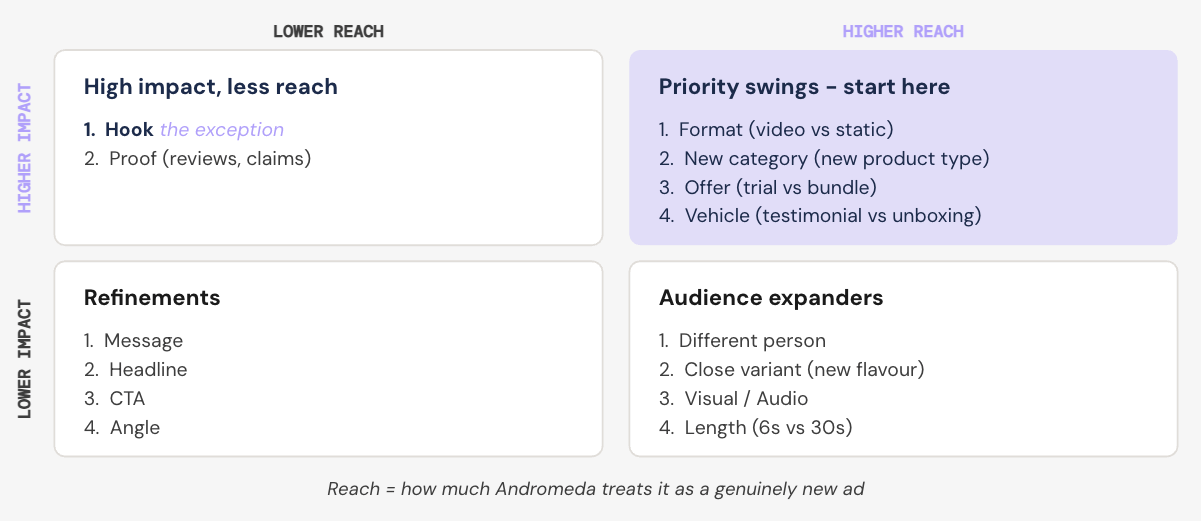
But not every change counts as new. Big swings, like format, concept, a new product category or the offer, unlock genuinely new reach. Smaller refinements, like the message, headline or call to action, sharpen a winner without reaching new people. The hook is the exception: the highest-impact single element on any ad. So produce across the big swings, rather than twenty versions of one idea. AI fills the volume gap; creators fill the trust gap.
Manual method: brief creators directly, edit in Canva or CapCut, and source creators through outreach.
Tool-assisted method: AI video and UGC generators like Arcads or makeugc, alongside creator marketplaces like TRIBE or Insense.
Blind spot: making more of what’s comfortable, rather than what’s genuinely different.
3. Test
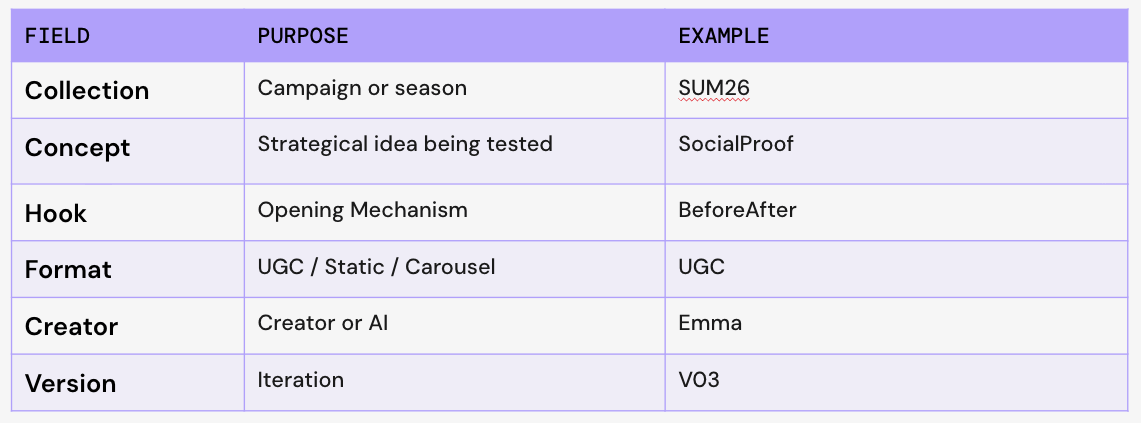
You have produced different assets; testing is how you discover which ones work. This depends on one unglamorous requirement: a naming convention. Tag every asset by collection, concept, hook, format, creator and version, so you can slice the performance data later and answer the only question that matters: which worked, and why? Run tests always-on, with a fixed share of spend going into validation.
You don’t have to tag by hand. Build the naming convention into a spreadsheet that generates the names for you, and apply them with the same tool you use to upload creative to Meta in bulk, rather than adding each asset one by one. Set the convention up once, and every batch stays consistent and sliceable.
Manual method: a naming-convention spreadsheet & manual upload.
Tool-assisted method: a bulk-upload tool that carries your naming convention into Meta, plus creative analytics that auto-tag and report (e.g. Motion, Markifact).
Blind spot: changing several things at once, or failing to tag assets at all, which leaves you with results that are impossible to read.
4. Learn
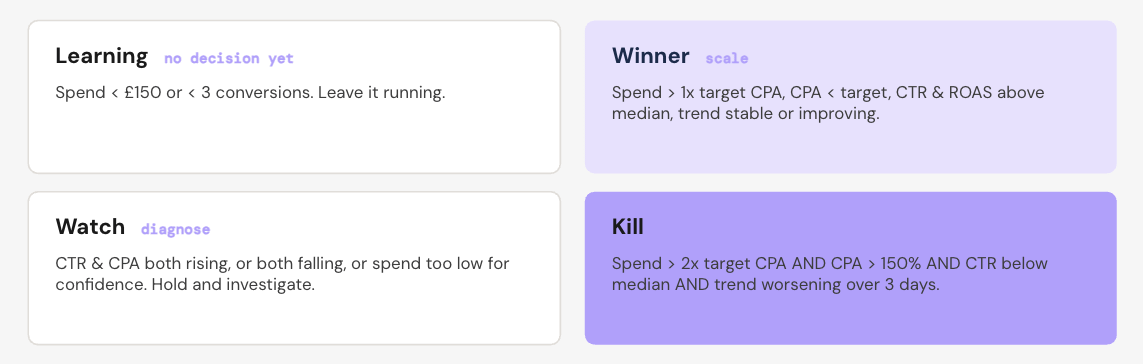
This stage separates a system from a treadmill, and it is the one most brands get wrong. Set rules for signal versus noise: decide when an ad is still learning, when it is a winner to scale, when to watch, and when to kill. Then, feed what you learned into the next brief. This connects back to the blind spot mentioned at the start. The insight lives in a deck and never reaches the creative. Reporting is not learning. A report tells you what happened, but learning changes what you do next.
Manual method: create a one-page rules document and conduct a weekly review of an Ads Manager export. Decide what to scale or kill, then write the next brief.
Tool-assisted method: use creative-analytics dashboards like Motion or a custom build that reads the Meta API.
Build It Block by Block
You won’t have this overnight, and you don’t need to. Each stage is a block you can stand up on its own. Start where it hurts most, usually the intelligence in Plan or the feedback loop in Learn, because those are the two most often missing. Get one working, then connect the next.
For each block, choose the level that fits: do it manually, buy a third-party tool, or build something custom. A small team running the loop by hand can beat a bigger competitor whose loop stays open.
Then it compounds. A one-off winner is a good week; a system that learns is a widening lead. Every cycle sharpens the next brief, while brands with open loops keep starting over. That is the one edge in paid media you build rather than rent.
Creative is the lever. The system is how you pull it, again and again, a little better each time.
Want to Know More?
We are walking through this whole method, end-to-end, with live examples, at our THRIVE Paid Media webinar on 15 July. We will also cover the half we didn’t get to here: capturing the demand your creative generates, through AI Max, product data and your site alongside Athos Commerce
 | A guest post by
|