


Executive Summary
Agentic commerce represents a shift in how digital transactions happen. Instead of simply helping people find products, AI agents are increasingly performing tasks on their behalf. Users can delegate actions such as searching, comparing options, ordering, and paying, stepping in only when needed. Early experiments in China show how this model works at scale. Platforms such as Meituan, Alibaba, Ant Group, and ByteDance are testing systems that interpret user intent and execute transactions across tightly integrated digital ecosystems. China has become a test environment because several enabling conditions coexist (more below). Maybe you won’t be acting on all of this today, but if your board asks what you need to do to stay ahead, you’ll have a good answer.
We’re all reading about how AI agents will be the ones searching and shopping in the future.
You can get your head around it in theory.
But how does it actually look in practice, day to day?
I came across this HBR research piece (link at the end) and thought it was essential reading for anyone in eCommerce right now. It’s one of the clearest pictures I’ve seen of where the industry is heading, and China is already living it.
The short version: AI agents aren’t just helping people shop. They’re already doing the shopping for them.
Meituan’s Xiaomei agent is the standout example. A user says, “Order my usual lunch, but deliver it 20 minutes later,” and the agent handles everything. Interprets intent, applies preferences, and completes the transaction. No browsing, no clicking, no funnel.
This is what we’re all calling “agentic commerce”, and it’s shifting from novelty to structural norm in China’s biggest platforms.
Agentic commerce represents a shift in how digital transactions happen. Instead of simply helping people find products, AI agents are increasingly performing tasks on their behalf.
Early experiments in China show how this model works at scale.
First of All - Why China?
It comes down to infrastructure. Five conditions have aligned there that don’t exist together anywhere else yet:
Embedded digital payments (Alipay, WeChat Pay)
Dense logistics networks
Super-app ecosystems spanning multiple services
A consumer base that adopts new behaviour fast
And a regulatory environment that lets things run before the rules are written
Worth noting: 83% of consumers in China see AI products as more beneficial than not. In the US, that figure is 39%. The UK isn’t there yet, but we typically mirror similar behaviour to the US market, albeit a bit slower.
What This Actually Means For Your Brand
Maybe you won’t be acting on all of this today, but if your board asks what you need to do to stay ahead, you’ll have a good answer.
The traditional marketing funnel assumes a human is doing the browsing, clicking, and deciding.
Agentic commerce removes the human from the middle. This is already happening with certain stages of the Search Funnel, i.e., comparisons and ‘best under X’ searches.
An AI agent filters the options before your customer ever sees them.
That creates a new dual requirement: be persuasive to people, but eligible to machines.
What we’ve noticed with clients is that they over-focus on the last click and a user handing over full control to buy a product, but agentic is more than that.
Agents embedded within Search
As of May 20th, Google also announced how agents will now be playing a much bigger part within Search itself > https://blog.google/products-and-platforms/products/search/search-io-2026/
Competing For The “Agent Answer,” Not The Human Funnel
Two big shifts follow from this.
Brand marketing stays important, but for a different reason. Humans still input preferences into an agent. “Order from Nike,” not “find me any trainer.” Brand meaning and preference still matter upstream.
Performance marketing gets disrupted the most. Click-through rates, conversion optimisation, traffic acquisition... all of that logic assumes human attention is the scarce resource. When agents do the filtering, you’re no longer competing for clicks. You’re competing to be included in the agent’s answer.
The researchers call this competing for the “agent shelf.” What gets you on it has nothing to do with creative or media spend. It’s service reliability, fulfilment rates, clear return policies, structured product data, and clean operational signals. Machine-readable trust.
The Two Things Worth Acting On Now
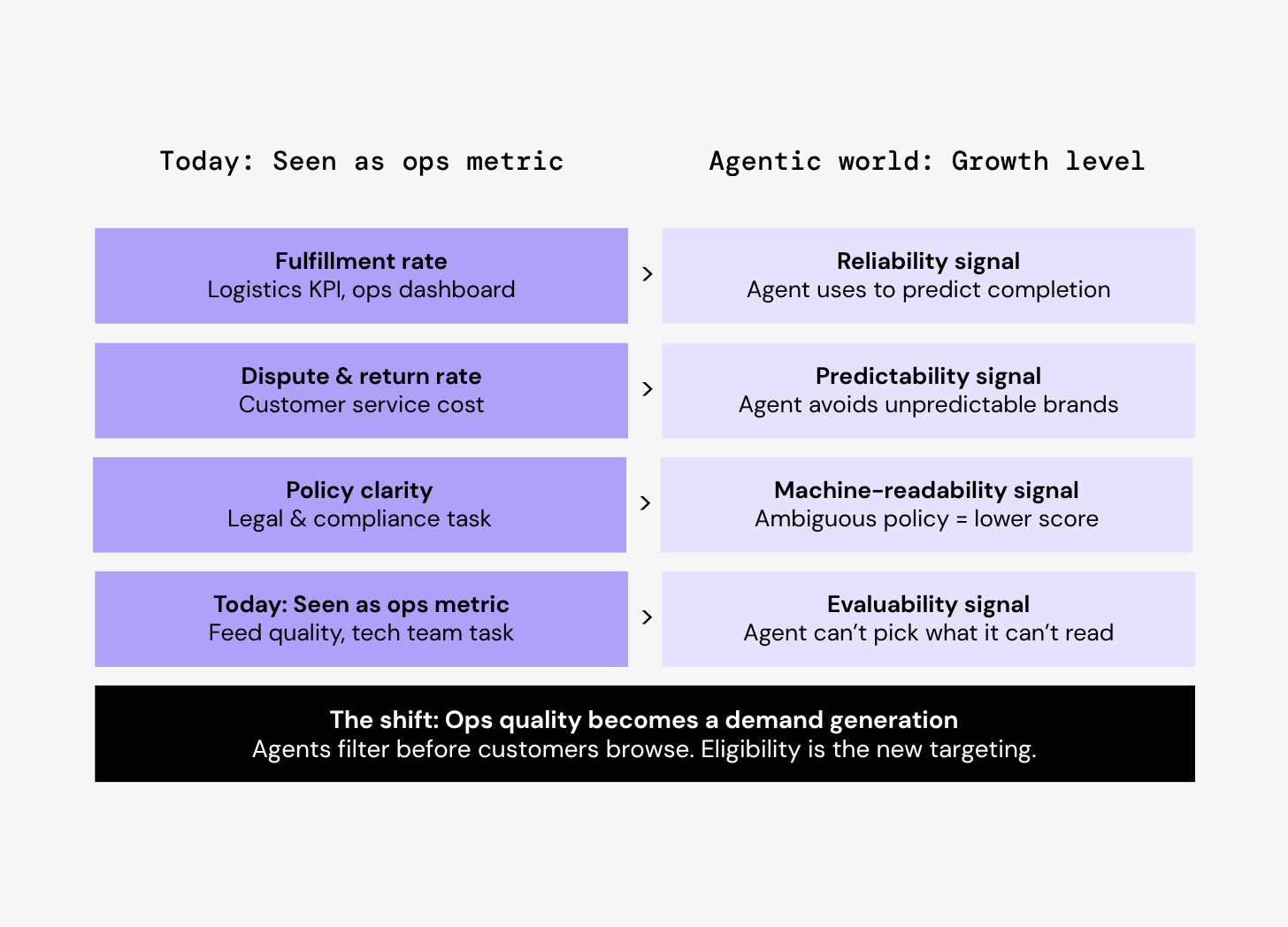
1. Treat agent eligibility signals as a marketing priority, not just an ops metric
We know brand sentiment plays a big part in AI search - but what can you do about it?
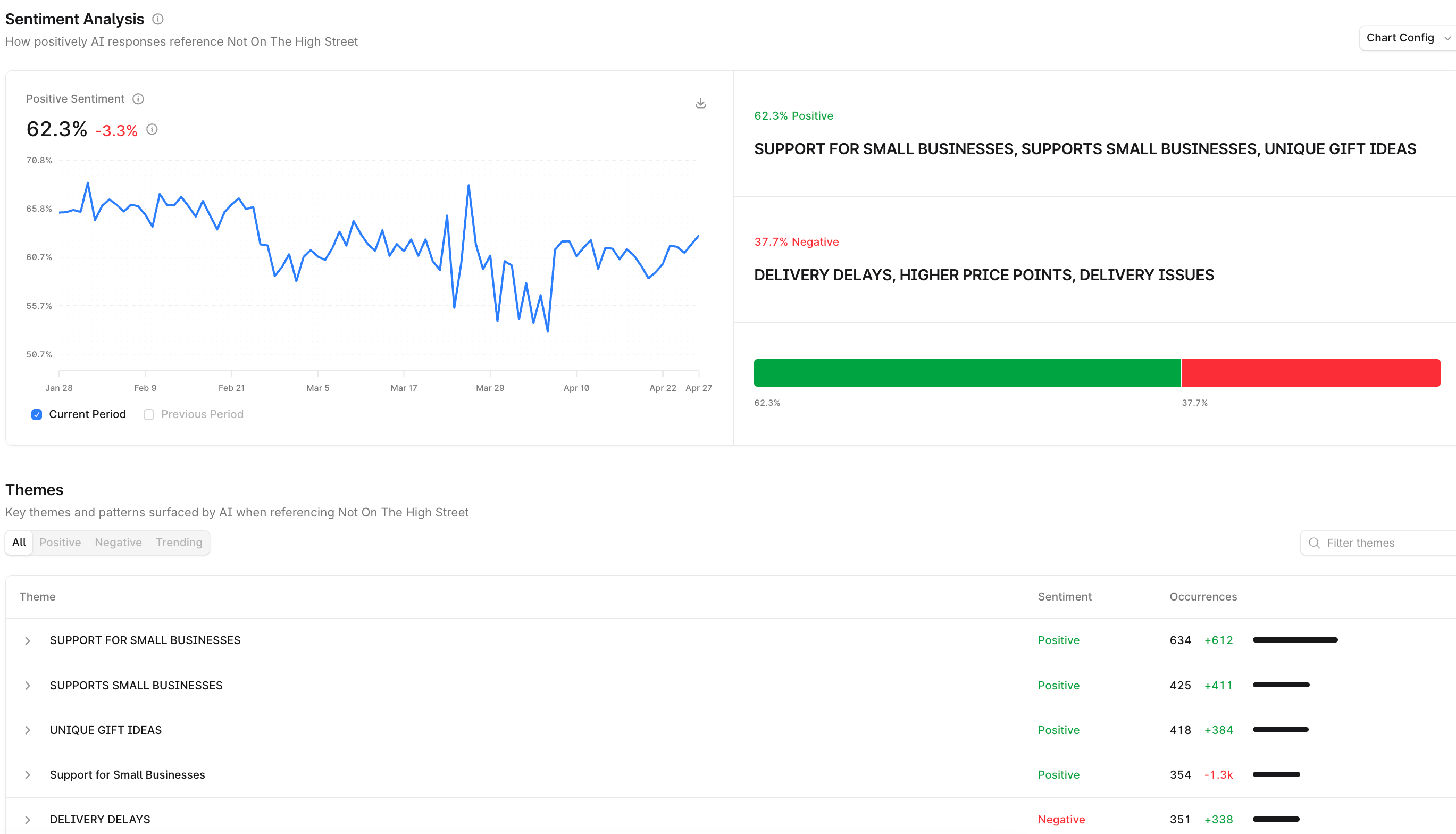
Right now, a weak returns policy or a slow dispute resolution time costs you a few customer service tickets.
In an agentic world, it costs you placement on the agent’s answer entirely. The penalty for operational issues moves from “annoying” to “invisible.”
If you want to see what this looks like in action, join our webinar early June when our team, along with SEO lead Abishek from YuMove, will be running through how they’ve mined customer service data to support SEO+GEO: https://luma.com/488dv35h
2. Map which parts of your customer journey could be delegated to an agent in the future
The researchers frame this as an “agent delegation map.” The core question is which decisions in your customer’s journey can move to autopilot, which must stay human, and where are the non-negotiable checkpoints?
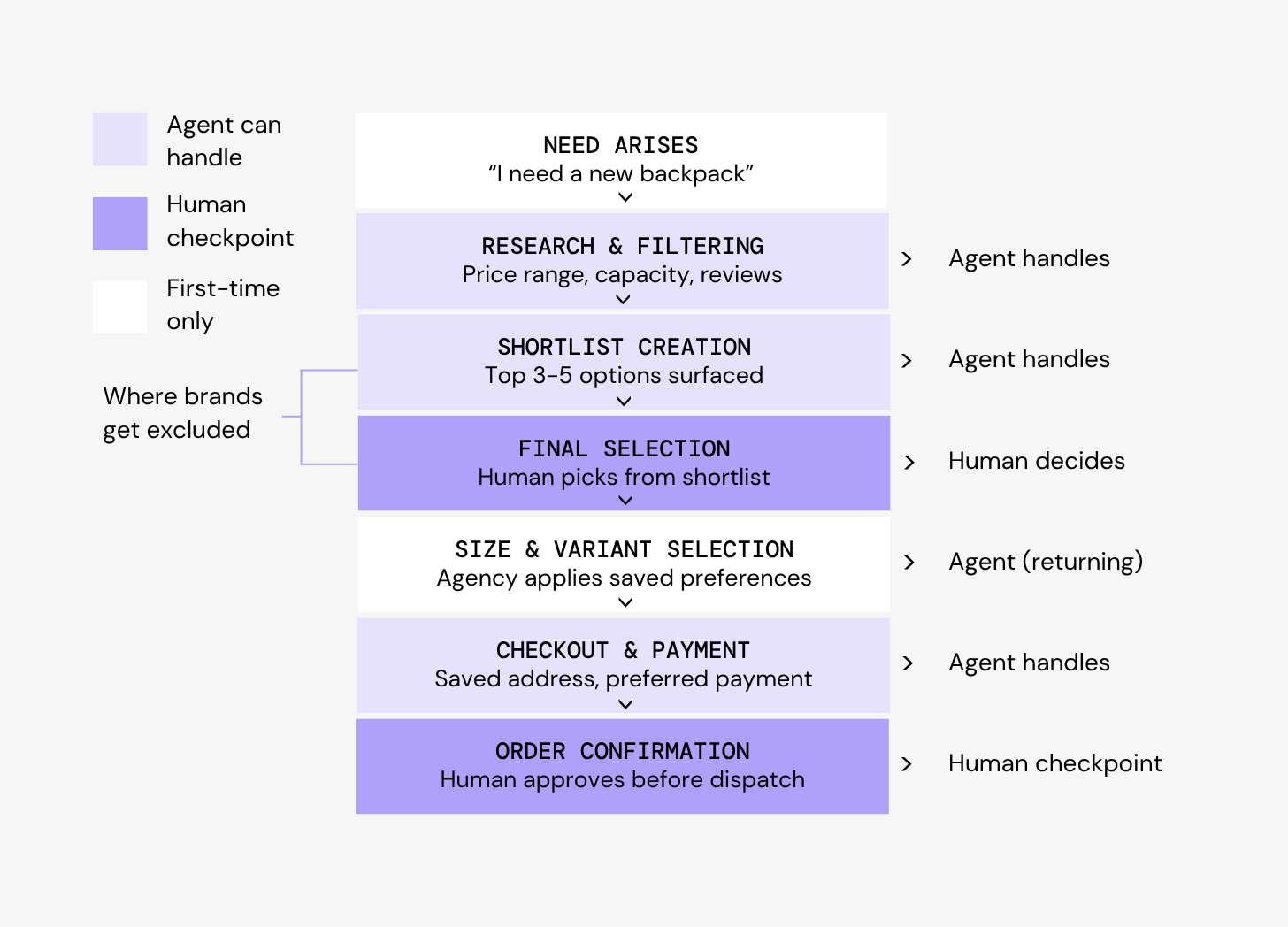
The key focus is on the bracket on the left.
Research, shortlist creation, and final selection are the three steps where brands either make it onto an agent’s shortlist or don’t, and that happens before the customer is ever involved.
For every step in your journey, ask two questions:
Does this require a genuinely new human decision, or is it just friction?
If an agent is handling it, what signals is it using to decide whether to include your brand at all?
Are we just writing for robots again?
No. It's not about being "robot-friendly" - it's about being agent-eligible.
With SEO, we optimised for bot-readable HTML because search engines decided what to show humans.
With agentic commerce, the structure is the same, but the stakes are different. Users still set intent, but the agent filters what they see. So yes, you need machine-readable trust signals, but you’re not writing for robots. You’re writing for humans who’ve delegated their filtering to one.
What changes is that you can’t hide operational weaknesses anymore. A clunky returns process that annoyed a few customers before? Now it’s a data point the agent weighs before your brand is even shown. Sloppy product data that users could work around? The agent can’t.
You’re still building for your customer. You’re just making sure the agent can understand what you’re offering well enough to recommend you.
The Bottom Line
This isn’t a 2030 story; in the US, Walmart and Google already announced a partnership in early 2026 to integrate Walmart’s inventory directly into Gemini for agent-led shopping.
Consumers are already delegating search to agents.
It will expand further down the funnel.
The question isn’t whether your customers will delegate their shopping to AI, it’s whether your brand is designed to be chosen by the agent acting on their behalf, not just the person browsing.
This post has been a summary and adaptation for you, but it’s worth a read in full (if you have a subscription).
Source: Research: What China’s AI Agents Reveal About the Future of Commerce, Harvard Business Review, April 2026 https://hbr.org/2026/04/research-what-chinas-ai-agents-reveal-about-the-future-of-commerce*
Interesting shift from “winning the click” to “winning the agent recommendation.” The point about operational signals becoming marketing signals is probably the biggest long-term change for ecommerce brands.