

Everyone Says Product Data Matters. Nobody Tells You Where It Starts.
Everyone agrees that better product data leads to better visibility. What almost nobody explains is how to actually improve it - until now.

Improve your product data.
It’s probably the most common piece of advice in ecommerce. Google says it. SEO experts say it. Paid Media agencies say it. AI experts say it. Everyone agrees that better product data leads to better visibility, better campaigns and better customer experiences.
What almost nobody explains is how to actually improve it.
Where does product data start? Who owns it? Should you invest in a PIM? A Product Feed Management platform? Or both?
After speaking with ecommerce brands over the past year, I’ve noticed these questions come up again and again.
The terminology is often confusing, and many businesses end up investing in the wrong tool because they don’t fully understand the problem they’re trying to solve.
This article is my attempt to change that.
Product Data Used to Have One Job. Now It Has a Dozen.
Five years ago, product data mainly needed to be good enough for your website. Before the rise of LLMs, Product Detail Pages (PDPs) were often treated as boilerplate pages, while most optimisation efforts focused on Product Listing Pages (PLPs) to improve traditional SEO. Today, AI-powered search and LLMs are changing that. They increasingly discover, compare and recommend products using the information on your PDPs, making rich, structured product data one of the highest priorities for ecommerce brands. The same underlying attributes now power your website, Google Merchant Center, Meta catalogues, Pinterest, Amazon, and the next generation of AI search experiences.
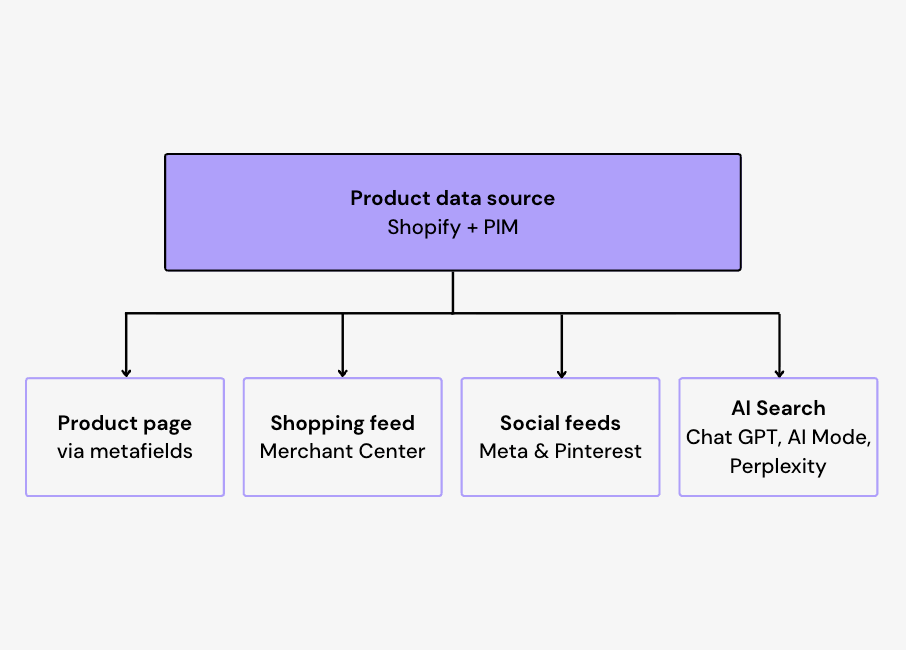
Every one of these channels depends on the quality of that underlying information. That’s why product data is no longer owned by a single team. It has become a shared asset across merchandising, SEO, Paid Media, CRM and increasingly AI.
What Actually Happens on the Product Page
To be precise about how this actually works: it isn’t that one piece of copy appears everywhere unchanged. What travels across systems is structured data, things like material, size, ingredients or technical specs, usually stored as attributes or Shopify metafields.
On a modern Shopify theme, those metafields can be pulled dynamically into a product page section, so a spec table or size chart on the page can genuinely be a live read of the same attribute that also feeds a Merchant Center export. Free text like the hero description is still usually written by hand for that page specifically.
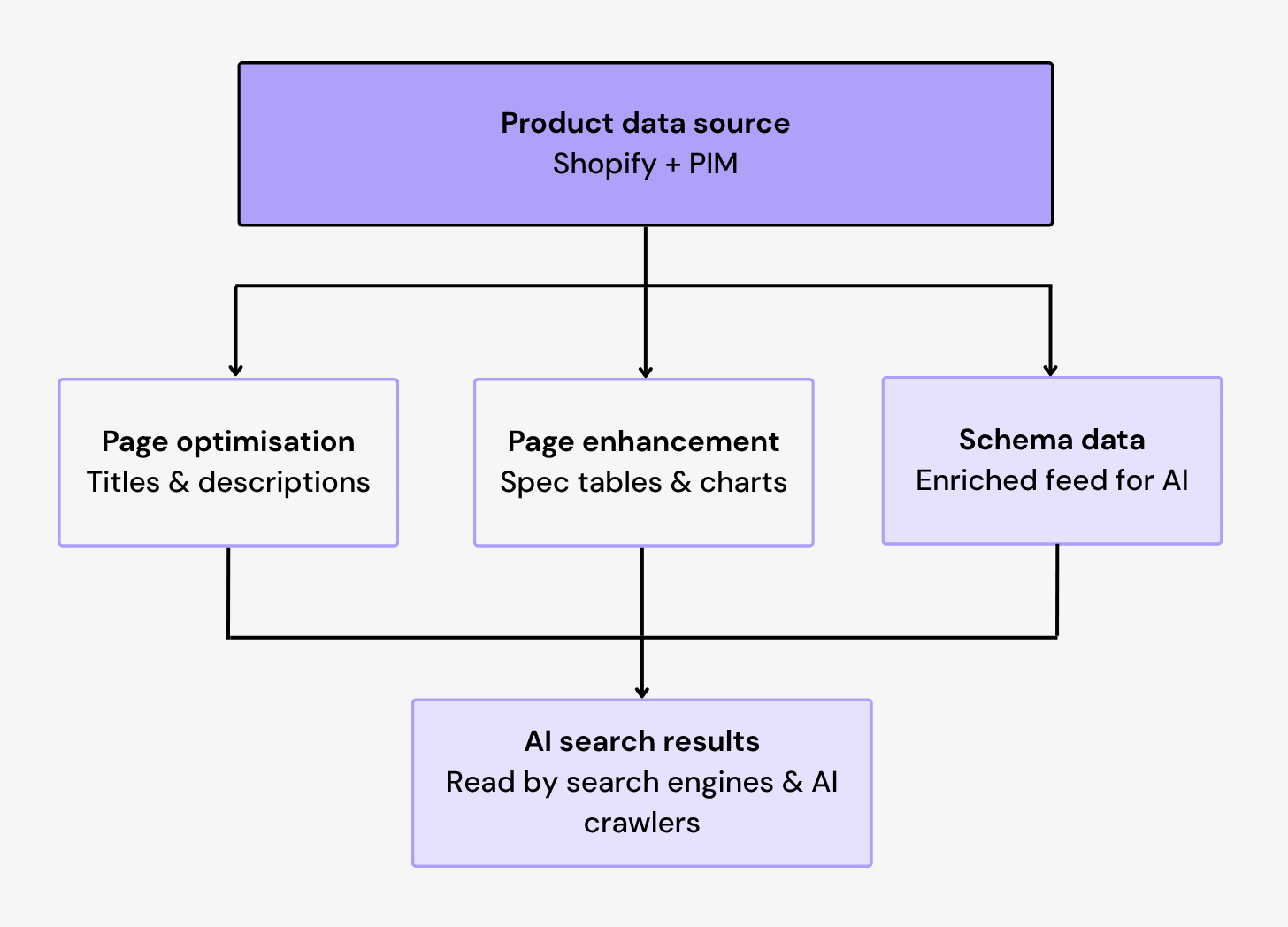
That’s also where a PIM’s contribution to the PDP actually sits. It doesn’t rewrite your product page directly; it enriches and validates the attributes upstream, so what lands in Shopify, and therefore on the page, is already accurate and complete rather than being fixed five times in five different tools.
Worth splitting “product page” into two separate jobs, because they behave differently. Page optimisation is the visible copy, titles and descriptions refined using the enriched data. Page enhancement is new structured content added to the page itself: spec tables, size charts, comparison data. Both stay on the page. Schema data is different again: it’s the structured markup embedded in the page that a shopper never sees, but that search engines and AI crawlers read directly. In that sense, schema data behaves like a feed, in the same way a Merchant Center export is a feed, except it’s the one AI Overviews and AI search tools actually parse to cite the product accurately. That’s why the enrichment work upstream matters twice over, once for what a person reads, once for what a crawler reads.
Merchant Center Consumes Your Data, It Doesn’t Create It. But There’s a Nuance Worth Naming.
One misconception I hear constantly is: “We optimise our product data in Merchant Center.”
Not quite. Merchant Center doesn’t originate product information; it ingests a feed. The same is true for Meta, Pinterest and Amazon. Your product information is created much earlier, usually inside Shopify or another ecommerce platform, which then distributes it outward.
Here’s the nuance. If you connect Shopify to Merchant Center through the native app, you can actually go into Merchant Center’s own interface and override individual titles or descriptions on top of that synced feed. That’s a real, if basic, first form of feed management, not nothing. It’s just limited: manual, one product at a time, with no testing framework behind it.
That points to a maturity ladder that’s worth naming explicitly.
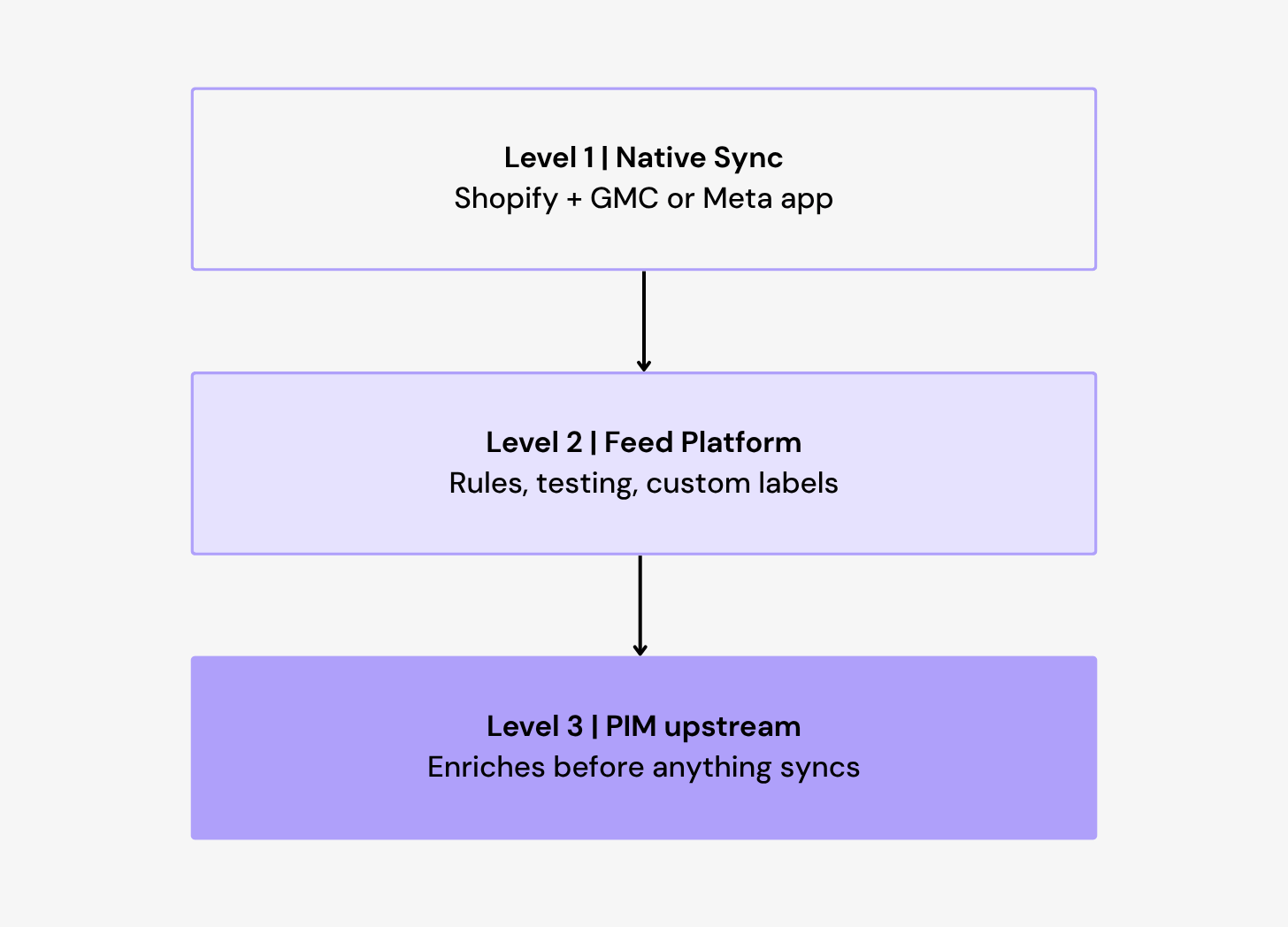
Level 1 is native sync, Shopify connected to GMC or Meta with manual overrides in the platform’s own interface.
Level 2 is a dedicated Feed Management platform, which adds rules, testing and systematic differentiation between channels.
Level 3 is a PIM sitting upstream of both, fixing the data at the source so every downstream sync starts from something clean.
It’s worth being honest that adoption order and the correct data flow order aren’t the same thing. Most brands adopt in the order above, because a feed tool is quick for a marketing team to bolt on without touching the underlying data model. But structurally, a PIM sits upstream of the feed tool, not after it. If you’re building for scale rather than patching a symptom, the PIM is the more foundational fix, even though it’s usually the one adopted last.
Shopify Handles Commerce Well. Product Information at Scale Is a Different Problem.
This isn’t a criticism of Shopify. I’m a big fan, and for most ecommerce businesses I think it’s the best platform available. It has made huge improvements in recent years too, with metafields, metaobjects, richer product taxonomies, bulk editing, AI features and APIs that make product management far more capable than it used to be.
The question isn’t whether Shopify can store rich product information. It absolutely can. The challenge is operational.
If you’re managing 50 products, Shopify is more than capable. Even a few hundred can be managed comfortably. In fact, Shopify’s opinionated product model is one of its biggest strengths. It keeps product management simple, consistent and easy to govern. But as the business grows, so does the complexity: more products, more suppliers, more collections, more markets, more languages, more teams. SEO wants richer descriptions. Paid Media wants richer Shopping titles. Merchandising wants cleaner categorisation. CRM wants more customer attributes. Everyone is working from the same catalogue.
That simplicity starts to become a constraint once brands need more advanced merchandising or product data optimisation. It’s one of the reasons sector-specific commerce platforms like Centra have become so popular in industries like fashion, where merchants often need much greater flexibility in how products, variants and catalogues are structured.
This gets sharper once you’re running multiple markets, languages or brands through the same storefront. A single product might need a UK title, a German title, a French title, a different price and currency, a different regulatory disclaimer, and a different brand name entirely if it’s sold under more than one label on the same catalogue. Multiply that by a few thousand SKUs and editing by hand inside Shopify stops being tedious and becomes genuinely unmanageable, not because Shopify can’t hold the data, but because no single team can keep that many versions of the same fact consistent by hand. That’s usually the moment a PIM stops being a nice-to-have and becomes the only realistic way to keep the catalogue accurate.
At that point, the challenge stops being about storing product information and starts being about managing it consistently. That’s where a PIM starts to make sense.
WTF is a PIM, and What Does a Feed Platform Actually Do?
PIM stands for Product Information Management.
Forget the acronym for a second. A PIM isn’t another ecommerce platform, and it doesn’t replace Shopify. Its job is simpler: it helps businesses manage product information at scale. Think of Shopify as your commerce platform and a PIM as your product information platform.
A good PIM centralises all of your product information in one place. It allows you to enrich product attributes, validate data quality, collaborate across teams, manage digital assets, translate product content, onboard supplier data and maintain a single source of truth.
For example, imagine a supplier sends a product specification sheet with inconsistent naming conventions, mixed units of measurement and missing attributes. Instead of manually fixing those issues across multiple platforms, you clean and standardise the data once in the PIM. That enriched product data then flows consistently to Shopify, Google Merchant Center and every other connected channel.
This is also where AEO (Answer Engine Optimisation) actually starts, not with the schema data mentioned earlier, but with what feeds it. When an AI engine answers a factual question about your product, it needs one clean, unambiguous answer, not five slightly different versions scattered across your channels. Ask an AI assistant what a product is made from, and it pulls from whichever mention it finds first: your PDP, a marketplace listing, a retailer’s own description. If those disagree on the material or the dimensions, the AI engine isn’t wrong; your data is. That’s a data governance problem before it’s an optimisation problem, which is exactly the layer a PIM sits at.
If you’re new to PIM, Plytix is a sensible place to start, particularly for growing ecommerce teams. It has a free plan so you can trial it before committing, and its Pro tier starts at €499 a month, a fraction of what enterprise platforms like Pimcore, Salsify or InRiver typically cost. It’s quick to implement and helps growing brands introduce structured, validated product data without a lengthy rollout. For businesses looking for a more AI-native approach, platforms like Emfas are also emerging, positioning themselves as AI-powered PIMs that help enrich, govern and optimise product information across multiple commerce platforms, not just Shopify.
A Product Feed Management platform is a different job entirely. It doesn’t manage your catalogue; it optimises how that catalogue performs across channels. Think of it as the marketing layer sitting on top of your product information. Unlike your ecommerce platform, a feed isn’t constrained by what appears on your website. You can create channel-specific titles, descriptions and attributes that maximise performance without changing the customer experience on your storefront. It helps answer questions like which Shopping title performs best, which products deserve a High Margin label, and which feed experiments actually move CTR or ROAS.
For example, your brand team may insist on calling a product “Performance Running Shoe”, while paid search data shows users search for “Men’s Running Trainers”. Changing the product name on your website might create branding issues, but a feed management platform lets you optimise the Google Shopping title independently, without affecting your storefront. The same principle applies to descriptions, custom labels, category mappings and channel-specific attributes.
Many of these platforms now include AI features that rewrite titles or enrich attributes, and those are genuinely useful. But their real value is experimentation: they exist to help marketers continuously test how product information is presented across channels.
If you’re new to Feed Management, Channable is a sensible place to start; it’s built for exactly this stage and is widely used across UK and European ecommerce. Larger operations with heavier catalogue complexity often graduate to platforms like Feedonomics or Athos Commerce, which support more advanced rule engines, workflow automation and higher SKU volumes.
Why They Complement Each Other
A Feed Management platform can only optimise the information it receives. If the underlying product information is incomplete, inconsistent or poorly structured, you’re asking the platform to optimise weak foundations. Garbage in, garbage out. That’s why I don’t see PIMs and Feed Management platforms as competitors. I see them as complementary:
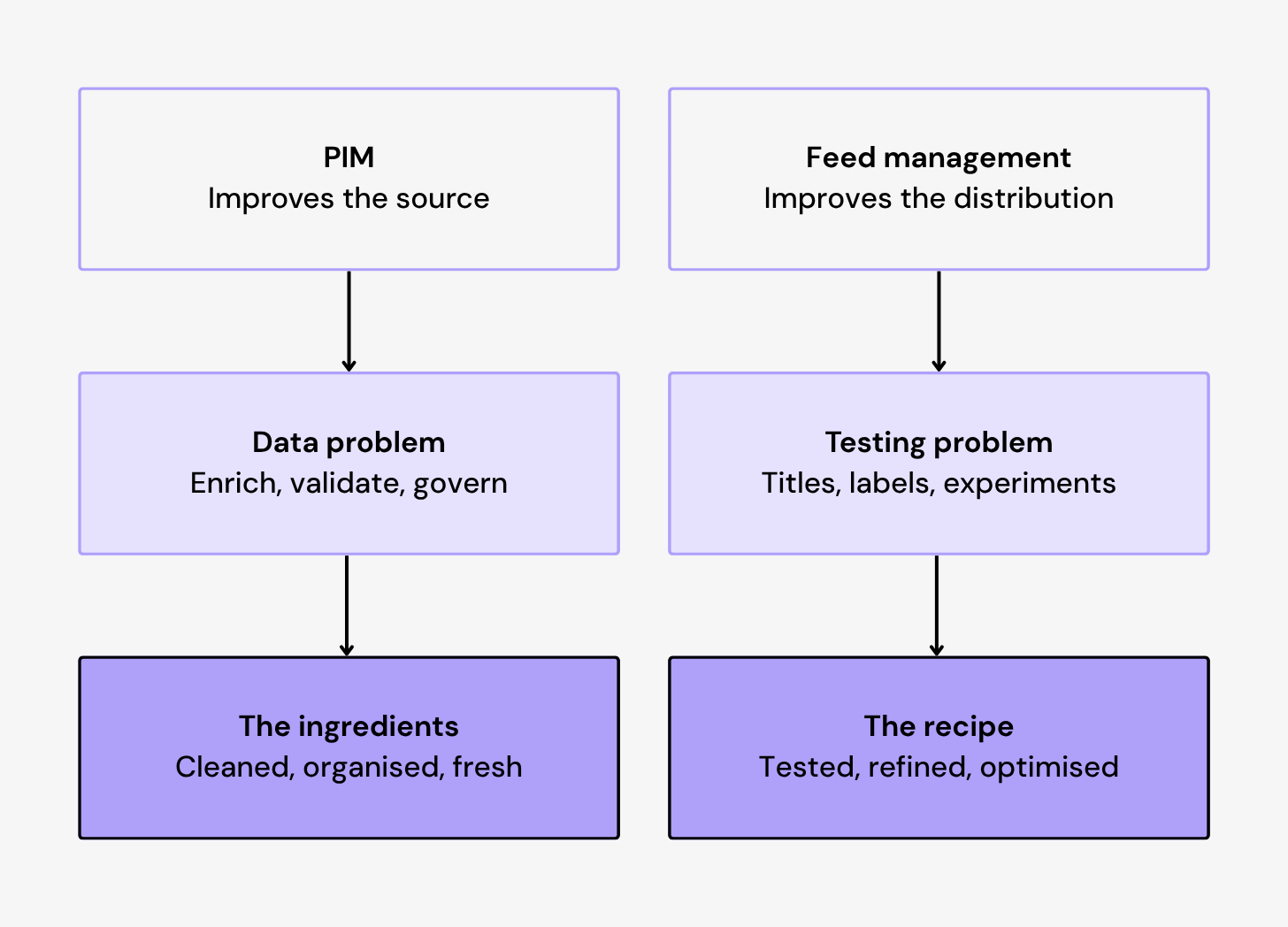
PIMs improve the source
Feed management tools improve the distribution.
The easiest way I’ve found to explain this is with cooking. A PIM is like preparing ingredients in a professional kitchen: cleaned, organised, labelled, fresh. A Feed Management platform is the chef, experimenting with recipes, adjusting seasoning, testing combinations, refining the final dish. If the ingredients are poor, no recipe produces an exceptional meal. If the ingredients are excellent but nobody ever experiments, you never discover the best-performing recipe. The best ecommerce brands do both.
Product Data Isn’t A Project You Finish
Product information isn’t something you finish; it’s something you operate, and the same is true of Feed Management: it’s an experimentation engine you keep running, not a setting you configure once.
That ongoing maintenance is also what’s quietly dissolving the old line between SEO and Paid Media, and now AEO too. All three are pulling on the same asset, which means the team that owns product data quality is, whether they realise it or not, also the team setting the ceiling on how well the brand shows up in AI search.
Which One Do You Actually Need?
There’s no universal answer; it depends on the problem you’re solving (and your budget).
IF…
You have a small catalogue that’s easy to manage, Shopify alone is probably fine.
Your product information is inconsistent, several teams touch the catalogue, you’re running multiple markets, languages or brands through one storefront, supplier onboarding is getting harder, or you want one trusted source of truth, look at a PIM.
You want to test Shopping titles, custom labels and channel-specific optimisation, look at a Feed Management platform.
You’re spending six figures a month on Paid Media with product feeds as a key acquisition lever, you likely need both.
To Summarise
The biggest misconception in ecommerce is that a PIM and a Product Feed Management platform solve the same problem. They don’t, and the difference isn’t subtle once you see it: one is a data problem, the other is a testing problem. A PIM helps you create, enrich and govern high-quality product information. A Feed Management platform helps you test, optimise and personalise that information for each channel. Confuse the two, and you end up optimising a recipe with bad ingredients, or perfecting your ingredients with no one ever cooking.
The impact is measurable, but it varies by retailer, category and the quality of the existing feed. Richer product imagery and more complete product attributes give Google’s systems more context to understand products, match them to relevant searches and generate more compelling Shopping listings. This can improve visibility, click-through rate and ultimately conversions.
That becomes even more important as Google rolls out AI Max for Shopping, where AI plays a much greater role in matching products to queries and generating assets from your product data. The better the underlying information, the more effectively Google’s systems can represent and recommend your products. A PIM creates that structured product data, while a Feed Management platform distributes and optimises it for Google Merchant Center and Google Ads.
You don’t need both from day one. Plenty of businesses will be perfectly successful with Shopify alone; others will benefit enormously from adding a PIM, and brands investing heavily in Paid Media often gain the most by combining both: a PIM to strengthen the foundation and a Feed Management platform to maximise performance on top of it.
In 2026, product information has become a strategic asset that underpins SEO, Paid Media, merchandising, AI-powered discovery and customer experience. As AI increasingly intermediates how consumers discover and evaluate products, the quality of your product data is becoming a competitive advantage rather than just an operational concern. The businesses that treat it as a continuous discipline, not a one-time project, will be the ones best positioned to grow.
If this article has made you think differently about product data, let’s continue the conversation in person.
This Thursday, 6 August, we’re hosting an exclusive breakfast roundtable at The Ivy Victoria in London, where we’ll discuss how product data is becoming one of the biggest drivers of Paid Media performance, AI-powered discovery, and ecommerce growth.
We’ll explore the product data priorities ecommerce brands should be focusing on in 2026, how to prepare for AI Max for Shopping and AI search, and the practical steps brands can take to scale Paid Media more effectively.
Only a few seats are remaining. If you’d like to join us, reserve your place here:
 | A guest post by
|