


Auditing Google Ads accounts, I keep finding the same issue across every industry and budget size: brand traffic mixed with acquisition traffic, hidden inside Performance Max or buried in Search campaigns. The numbers look fantastic but the business isn’t achieving incremental growth.
That’s the real question behind every account review: do we want Google Ads to look good in-platform, or do we want to grow the business? They’re not always the same thing.
What “Branded Traffic” Actually Means
Branded traffic is any search containing your company or product name. Someone searching “Nike Pegasus” or your brand name directly already knows you exist; they’re finding you, not discovering you.
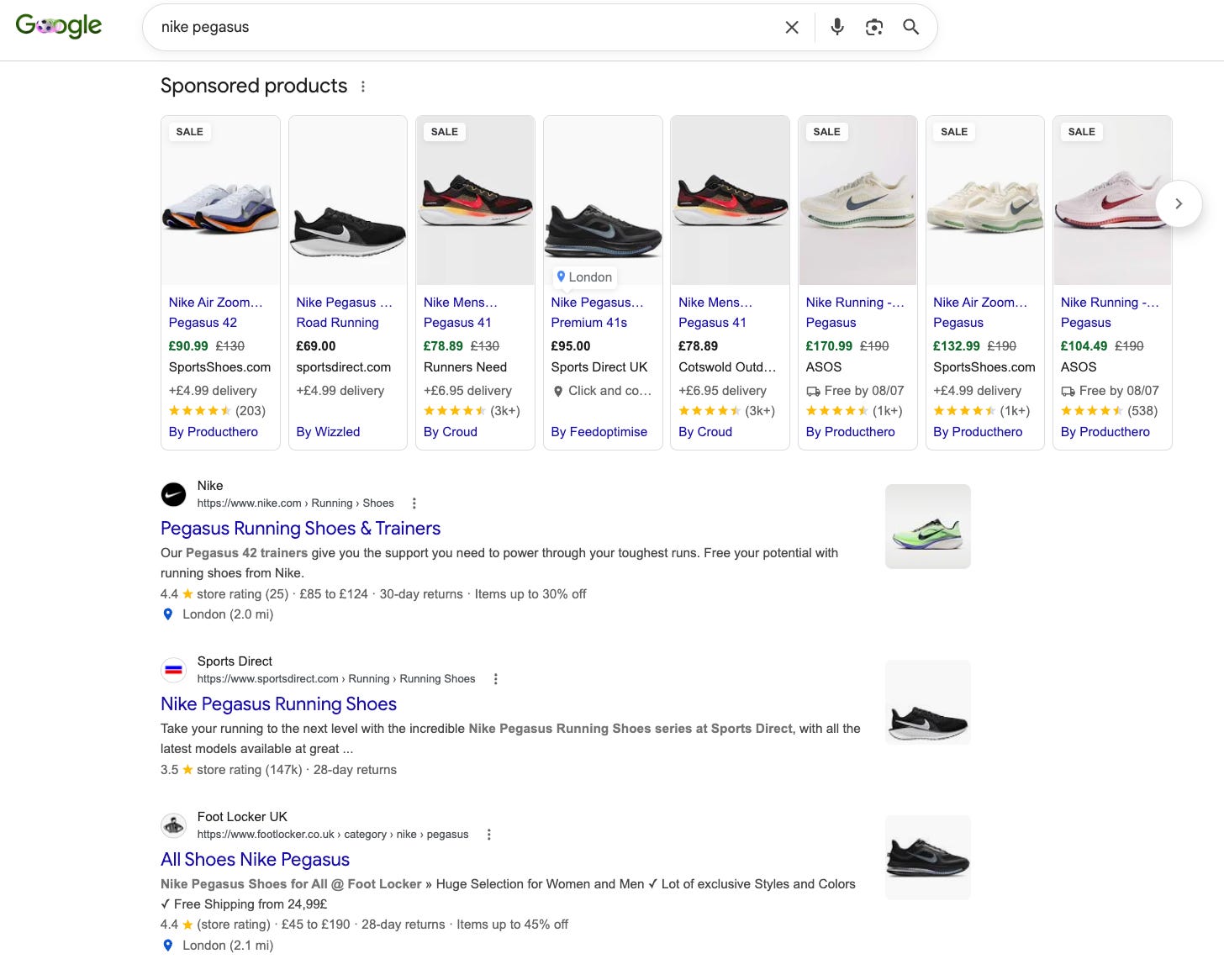
That distinction matters because branded and acquisition campaigns have different jobs. One protects demand, the other creates it. Google doesn’t separate them. It just maximises whatever goal you give it, and if that’s ROAS, it will default to the easiest conversions available: branded search.
Should You Bid On Your Own Brand?
It depends. If you’re a global brand selling through your own site, Amazon, retailers, and resellers, competitors and marketplaces are likely bidding on your name too. Protecting that space is worth it.
If you’re a growing ecommerce brand selling only direct, check Auction Insights. If nobody else shows up on your brand terms, you’re likely paying for clicks that would have reached you organically anyway.
Test it: reduce branded budget significantly, or pause it briefly. Watch organic traffic, total revenue, and whether conversions simply shift from Paid to Organic Search. If those hold steady, you’ve freed up some budget for actual customer acquisition.
We recently did this for one of our fashion clients, saving an estimated £15K per month, a budget that can either fund SEO investment, be reinvested into non-brand or upper funnel channels.
The Biggest Mistake I See
It’s not running branded campaigns; it’s mixing branded and non-branded traffic, usually inside Performance Max.
Example: your PMax campaign has branded searches converting at 30x ROAS and generic at 6x. Google flags it as “Limited by budget,” you increase spend, conversions rise, ROAS looks great. But that extra budget went to branded traffic, the path of least resistance for the algorithm. The dashboard improves. The business doesn’t.
What Marketing Mix Modelling (MMM) Tells Us
MMM looks beyond platform attribution, and the pattern repeats: branded search has relatively low incrementality. It still protects demand and market share, but much of that traffic would have converted anyway.
The campaigns driving real incremental growth- generic Search, generic Shopping, competitor campaigns- usually show the weakest platform metrics: lower ROAS, higher CPA. That’s because they’re finding customers who weren’t already looking for you.
The Account Structure I Recommend
One principle: separate intent.
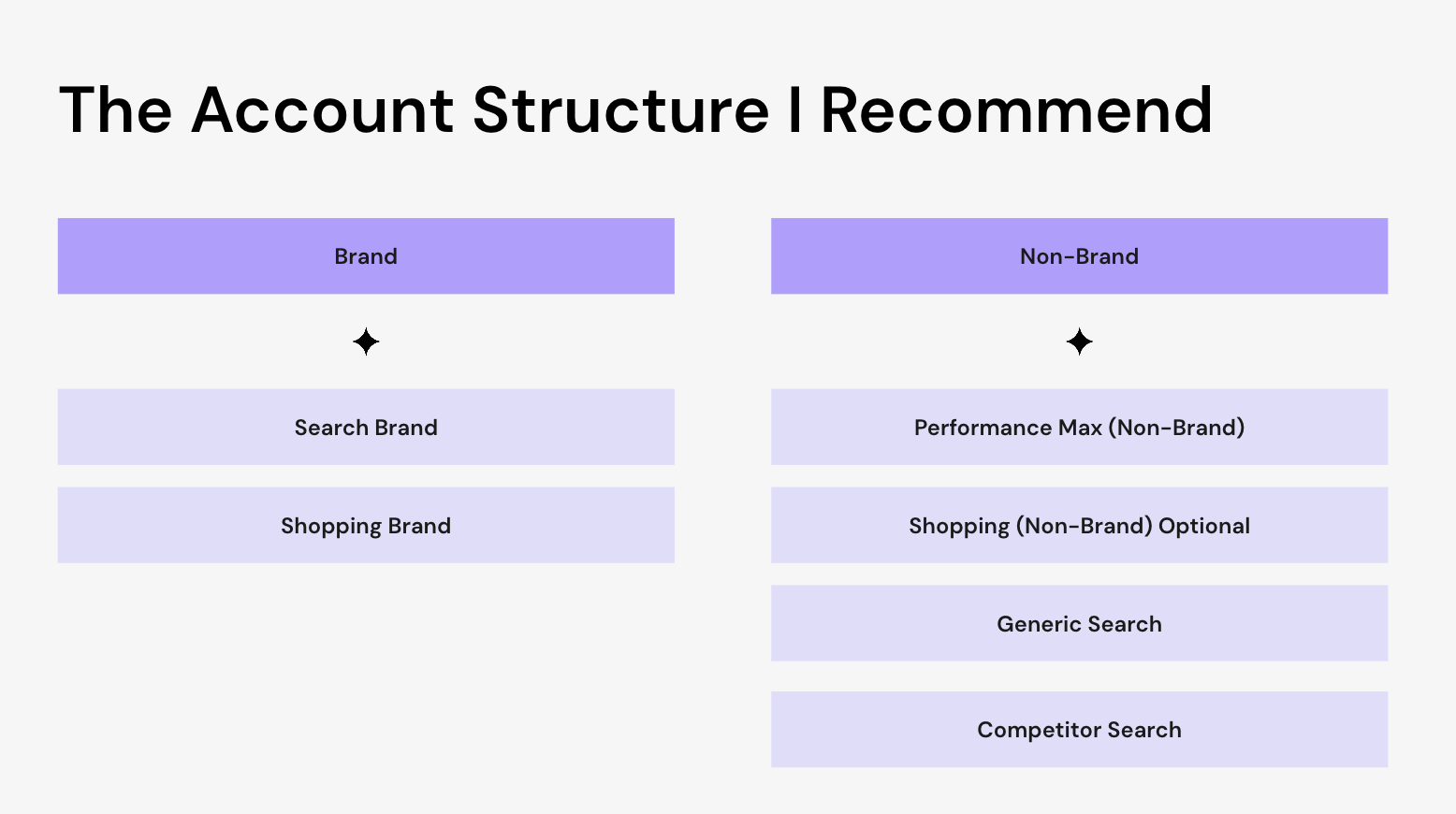
Competitor Search
This lets you report Brand and Non-Brand separately, see exactly where budget goes, monitor Impression Share independently, and stop branded traffic from masking acquisition performance.
How I Manage Branded Search & Shopping
How I manage branded Search and Shopping
Branded Search is a profitability and defence campaign, not a scaling one. Spend only what’s needed to own the results.
Impression Share targets
Business as usual: target 70-80%. Above 80%, returns diminish fast, and pushing toward 95-100% is self-sabotage. You can’t own every auction, so stop trying and redirect that budget where it works harder.
Peak periods (e.g. Black Friday): allow Search IS up to around 85%, to capture demand with an irresistible offer directly in the ad, something organic can’t do.
Match type
Search Brand: prioritise exact match. Phrase or broad match expands reach exactly where you don’t want it, brand is about lowering CPC and protecting visibility, not maximising reach.
AI Max: avoid it on brand traffic, since it’s built to widen reach and match. Use it on Search Non-Brand only, where expanding reach is the actual goal.
Bidding
Run Search Brand on Manual CPC, not automated strategies, since the goal is profitability and control, not scale. Two rules keep it simple:
If Impression Share falls below 80-85%, increase bids by around £0.03.
If it climbs above 95%, decrease bids by around £0.04.
Done consistently, this keeps the campaign lean and defends the range above, rather than letting Google chase 100% coverage.
What To Expect
Managed this way, branded Search should run at 70-100 ROAS consistently. It’s your profit engine and defence layer, not a growth lever, so keep it efficient and leave the acquisition budget for campaigns actually built to find new customers.
Shopping
Run a dedicated branded campaign with aggressive negative keywords to keep generic queries out (scripts can automate this daily). Shopping has no Manual CPC, so manage profitability through tROAS:
If Impression Share falls, relax the tROAS target by 5 or 10%.
If Impression Share holds, tighten the tROAS target by 5 or 10%.
Neither campaign is about volume. Both are about efficient protection.
Existing Customers Don’t Need A Branded Ad
This is most obvious with subscription businesses, but it applies to any brand with repeat purchasers. Brand protection still matters for prospects comparing you to competitors pre-signup or pre-purchase. Existing customers are different: someone who’s bought from you repeatedly doesn’t need a paid ad every time they type your name into Google. They’re logging in, reordering, or coming straight back to a site they already know.
If your CRM is solid and customer lists are refreshed regularly, exclude existing customers from branded campaigns. You still defend the brand for prospects while cutting spend on people who’d find you regardless. It’s another confident, low-risk way to reduce brand budget: for subscription businesses with high repeat purchase rates it can free up a meaningful acquisition budget, but the same logic holds for any brand with a loyal repeat customer base.
Where to Reinvest What You Save
Say you currently spend 25% of your budget on Brand and manage to cut it back to 15%. That’s 10% freed up. Where you put it matters more than the cut itself, and here you’ve really got two directions to choose from.
Reinvesting it into an unoptimised PMax Non-Brand or Search Non-Brand campaign probably won’t move the needle; those channels capture existing demand; they don’t create it. So the real decision is this: are you playing for the long game or the short one?
If you’re playing the long game, pull that budget out of paid entirely and put it into SEO. It takes longer to show up, but it builds an asset that keeps paying you back long after the campaign ends, unlike paid spend, which stops working the moment you stop paying for it.
If you want results sooner, keep the budget in paid media but move it upper funnel, into Demand Gen and YouTube. This is where you build brand equity and create the demand that Search and Shopping will capture later. It won’t compound the way SEO does, but you’ll see the effect faster.
The catch with the upper funnel route is that it only works with strong creative, ideally a proper creative system rather than one-off assets. If you want to go deeper on building a creative system that scales for 2026, we’re running a webinar on this on 15 July: luma.com/orsd3ywm.
Five Rules To Remember
Separate intent, always. Brand and Non-Brand should never share a campaign. If Google can find the easy conversion, it will take it every time, so don’t give it the chance.
Branded Search defends; it doesn’t grow. Keep Impression Share at 70-80% in business as usual, manual CPC, exact match only. A 70-100 ROAS here is expected, not impressive- it’s a profit engine, not proof of growth.
Test before you assume you need brand spend. Check Auction Insights, briefly pause the branded budget, and watch what happens to organic traffic and total revenue. If conversions shift from Paid to Organic, you were paying for clicks you’d have gotten anyway.
Exclude existing customers from branded campaigns. They don’t need a paid ad to find you; they’re already coming back. This is one of the lowest-risk ways to free up budget.
Reinvest with intent, not by default. Don’t let freed-up budget drift into unoptimised Non-Brand campaigns. Choose SEO for compounding, long-term growth, or upper-funnel paid media (Demand Gen, YouTube) if you need results sooner. Both beat leaving it in Brand.
One Final Thought
Google isn’t trying to grow your business; it’s maximising whatever objective you’ve set. If that’s ROAS, it will always favour the easiest conversions, and branded traffic is usually the easiest conversion you’ll ever buy.
The question isn’t whether your account delivered a 20x ROAS. It’s whether your marketing created incremental growth. Optimise for one or the other, they’re rarely the same choice.

This matches what we see auditing retailer accounts constantly: a "Limited by budget" flag gets treated as a green light without checking whether the incremental spend is simply being absorbed by branded Shopping placements. In practice the harder part isn't building the negative-keyword architecture you describe, it's getting finance to accept a lower blended ROAS on the non-brand campaign as the actually healthier number, since brand will always look better on a dashboard than the channels doing the real acquisition work.