

How To Build Personas To Help You Enrich Product Pages
Build Personas That Win Visitors & LLMs

Personas are having a revival.
Up until recently, personas have often been owned and utilised most by brand teams. However, historically, I’ve seen again and again personas being created, filed away, and never actively used. As discussed in our recent post, the way we are searching with AI is leading us to longer and more personalised search behaviour. Personas are the ideal solution to help capture these searches by understanding and segmenting your audience.
With the increasing importance of product pages due to the rise of AI and LLMs (which can supplant your research to consideration stages and get straight to product recommendations), personas are getting a fresh purpose and can help you build rich, relevant and genuinely useful product-based content on PDPs. Read on for our practical guide to leveraging personas to level up your PDPs.
What Makes A Helpful Persona?
Making sure your personas have enough helpful detail in them is vital. A common pitfall with personas is that they simply aren’t detailed enough to be useful on a meaningful level. Take the following example of a top-level persona, the likes of which I have seen many times.
Example of a sub-par persona:
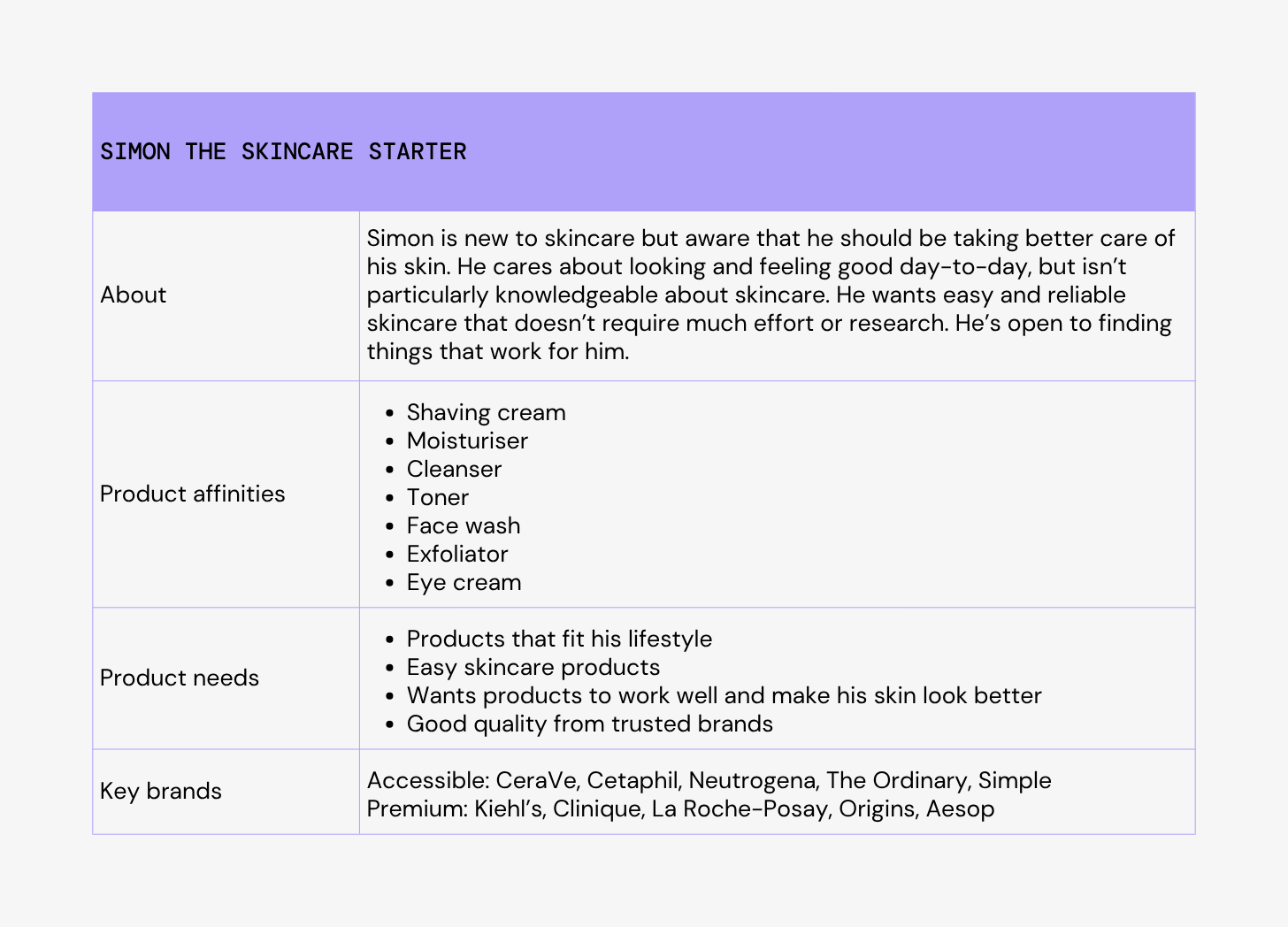
Yes, there’s the idea of a persona here, but there’s serious, useful detail lacking in ‘about’ and ‘needs’, and overly broad or optimistic products and brands.
When developing your personas, these are things that actually make them useful:
Specificity: aim for concrete details on demographics, motivators, needs and behaviours. This makes it easier to create products, content, messaging and experiences for a real type of person.
Be concise: whilst specifics are important, strike the right balance between rich vs overwhelming detail. Whilst vague personas are common, we also see some that try to describe everything. Stick to the most important aspects to ensure they’re helpful and not hard to use.
Realism: make sure you represent how real customers behave, not how you wish they’d behave. Whilst it can be tempting to push personas to have more product affinities with your offering, or align their motivations with your brand, being unrealistic will ultimately harm the success of your strategy.
Tips on How to Build Out Personas
1. Delve into your audience research & analysis
Most businesses will have carried out some sort of research or analysis on their customer base, and this is a useful starting point. Other sources of audience information can be: customer support feedback, feedback from sales teams, analytics data (e.g. from your CMS or GA4), Reddit analysis, third-party tools like SparkToro, and more. Pool what you can and start to get a shape of your key personas. How many to aim for depends on the breadth of your offering, but 3-6 is a manageable starting point.
2. Flesh out persona outlines with AI assistance
Once you’ve got an outline of your key personas from your audience, using LLMs can be a great way to flesh these out into useful profiles. Try to give as much useful information as you can in your prompting to get the best outcome. Feed in your relevant data, profile outlines and a good overview of your brand. From there you can prompt your chosen AI assistant to use all this information to outline a complete persona.
Pain points, motivations (buying and emotional) and demographics are absolute must-haves to make your personas useful. Other facets you can consider include:
Interests
Traits (lifestyle and personal)
Product affinities
Job/industry (and seniority where relevant)
Influences
Environment
Decision barriers
Review, iterate on, and edit what LLMs give you until you’re happy, remembering to aim for specific, concise and realistic profiles.
3. Perfect is the enemy of progress - you can iterate over time
It’s also worth keeping in mind that, as with many things, perfection can be the enemy of progress. I’ve worked with brands that start to get bogged down in the detail and data when building out personas - are the ages quite right according to analytics? Should we map all the pain points customer support encounters to a persona? Should we wait and create a new persona for a new product range we’re planning to launch in 2 months? Ultimately, getting out an agreed-upon MVP that gives you direction and an audience-focused mindset for improving your content and templates will be much more beneficial than delaying for perfection. It’s also positive to see personas as something you return to periodically and evolve with your brand over time.
So, How Do My Shiny New Personas Help My Product Pages?
By having a clear understanding of your personas, you can better tailor your product content and PDP templates so that they’re more helpful, user-centric and persuasive. Take ‘Simon the skincare starter’ again - we’ve iterated on the basic persona, and now we’ve mapped:
Pain point: he doesn’t understand and is overwhelmed by skincare jargon and ingredients
Pain point: long and complex skincare routines don’t fit into his daily routine
Pain point: he doesn’t know which brands to choose or trust
Motivation: wants to look polished, healthy, and like looks after himself well both in professional and social/dating settings
Motivation: prefers brands that don’t feel overly cosmetic or beauty-led
Motivation: social proof and guidance (straightforward advice and endorsements)
All this information can then be used to tailor product pages (and PLPs or content!) to provide a better experience for your persona. In practice, think about how you can take your basic product specs and make these more useful and relevant to your persona - for example:
‘SPF 30’ becomes ‘SPF 30 to protect against sun damage and premature ageing’
‘Contains hyaluronic acid’ becomes ‘Deeply hydrates and locks in moisture for smooth, fresh and brighter skin’
‘Gel formula’ becomes ‘Lightweight, fast-absorbing gel formula’
These are all designed to use clear, benefit-led and jargon-free language to appeal to Simon, aligning with some of his pain points and motivations.
Taking It Further With Product Attributes
We also recommend signposting helpful attributes in your product page (even better if you back them up with structured data). By going beyond basic attributes like product type, gender, colour etc, you can help your visitors understand if your product is well-suited to them. As well as offering clear benefits/functions like above, consider adding who or what use-cases your products are best for, and attributes specific to your niche. Following our example, in skincare, that might be things like skin type, product format, active ingredients, UV protection level, etc.
This detailed and user-centric approach has many benefits. Not only are you providing a richer and more helpful experience for your visitors, but this same information is also helpful for being cited by LLMs. With this rich, clearly defined information, you can help show your product is a great fit for the super long-tail “exactly what I want” type searches users opt for in LLMs that we’ve talked about previously. Furthermore, this exact same information can have a positive impact on AI Max and PMax paid campaigns, with additional details allowing smarter search term matching and discovery of new opportunities and emerging queries.
Scaling Changes With Page Template Features
One more helpful way to utilise your personas is to consider how their motivations and pain points can be aligned/alleviated within your page templates. For example, our Simon persona is motivated by social proof - seeing people like him have success with products and endorse them - as well as having a pain point around not knowing which brands are trustworthy. In this instance, a UGC/social or review module including real-life user imagery or videos on PDPs could satisfy both of his needs and be very helpful, encouraging conversion.
Chat to Us About Your Personas & Product Pages
Inspired to give your personas a new lease of life and see how they can be better utilised to enrich your PDPs? Get in touch to see how we can shape a persona-centric strategy for your brand.
 | A guest post by
|
The revival of personas makes sense. Search is becoming more intent driven, so understanding users at a deeper level is critical.