

Search has changed. Have you?
Search has changed. Have you?

LLMs have fundamentally changed search. Customers are now searching in hyper long tail, referred to as ‘this is exactly what I want’ search. LLM technology means this search intent can now be satisfied.
Search is now personalised. Customers are demanding personalised product information. If your site and product information aren’t personalised to signpost how your customers are searching, you are less likely to reach them now, and increasingly so in the future.
Search has changed. Have you?
How Search Behaviour Has Changed
The ultra longtail “this is exactly what I want” situational search
People are no longer searching with keywords; they are searching with personal “this is exactly what I want” situations. It is the rise of situation search.
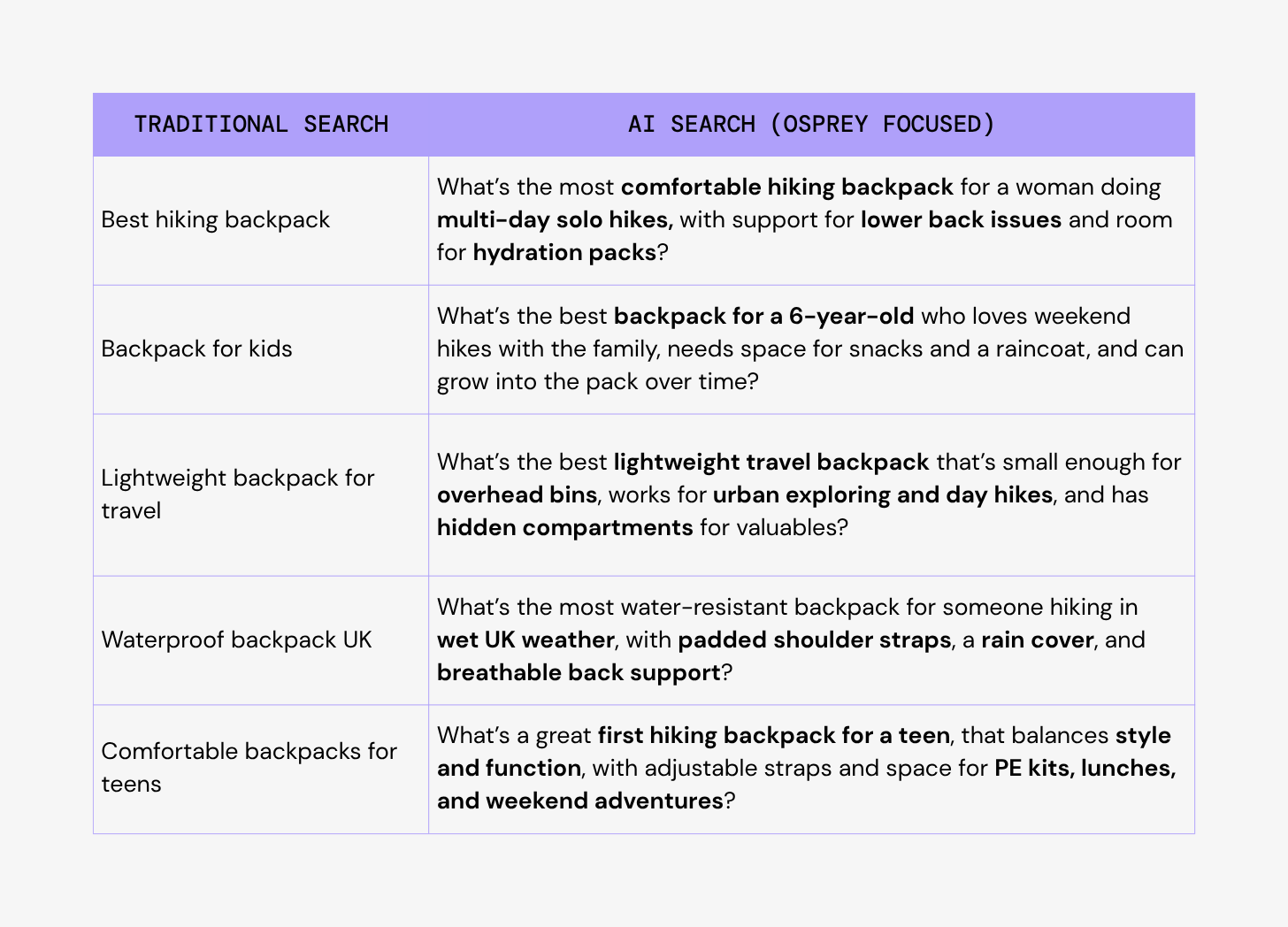
Source: https://ecommerce.thisisnovos.com/p/ai-search-future-proofing-your-content
Search has changed; the customer hasn’t
The customer is the same
The customer has not changed. Our customers still have the same situations; the same pain points to solve, or goals to achieve, for which our products may be the answer.
Search has changed.
How the customer searches for this information, and how this information is retrieved and presented, is now fundamentally different.
AI and large language models are now advanced enough to understand complex queries and reliably match the intent behind these queries to relevant sources with accuracy.
Previously, even if we had detailed customer persona information, because the vast majority of customers ended up searching for a product in a generally similar way, the actions we could take onsite were often limited. PLPs and categories ruled the roost. So this is where SEO actions were concentrated.
The depth of a search considered long tail may have also been 4-5 words long. This was still broadly predictable with only 1-2 key attributes. Ultimately, they lacked depth, so they could often be answered by PLPs or relatively generic content on PDPs. Now, customers are searching for ultra-long-tail terms, up to and surpassing 20+ words. There’s far too much context to answer without personalisation onsite. Situational search needs to be optimised for.
Longtail before - “Black rugby boots for backs”
Longtail now - “I am a 31-year-old man looking for rugby boots that I can wear on a muddy pitch. I play outside centre and want them to protect my feet. I want them to be flashy and last at least a couple of seasons.”
Search behaviour has changed
However, the ability for AI Search platforms to understand the context of a search and return exact information and pages for situational searches has changed this. PDPs, which contain more specific and tailored information, are on the rise. And since an eCom website typically contains many more PDPs than PLPs, the depth and specificity of information we can provide has expanded.
We can match personas’ situation searches with on-site PDP content.
Search is Now Personalised; Are You?
We can build out various customer journeys based on the specific situations that those customers would likely be searching for.

Situational searches are rarely random. They are usually expressions of the same motivations that sit behind your customer personas.
Just like in CRM, the dream is 1:1 email for every customer - i.e., personalised retention. However, the reality is this isn’t possible, CRM teams segment their database to personalise messaging - we need to take the same approach for Search. Search is now so vast with a hyper-long tail; if you talk to everyone, you talk to no one. You need to segment search using personas (i.e., personalisation).
This means persona research and mapping, often used in brand or CRM strategy, can now directly inform SEO content strategy. Different customer personas will require and relate to different types of content. For example, a client we work with has 3 distinct customer personas, shown below:
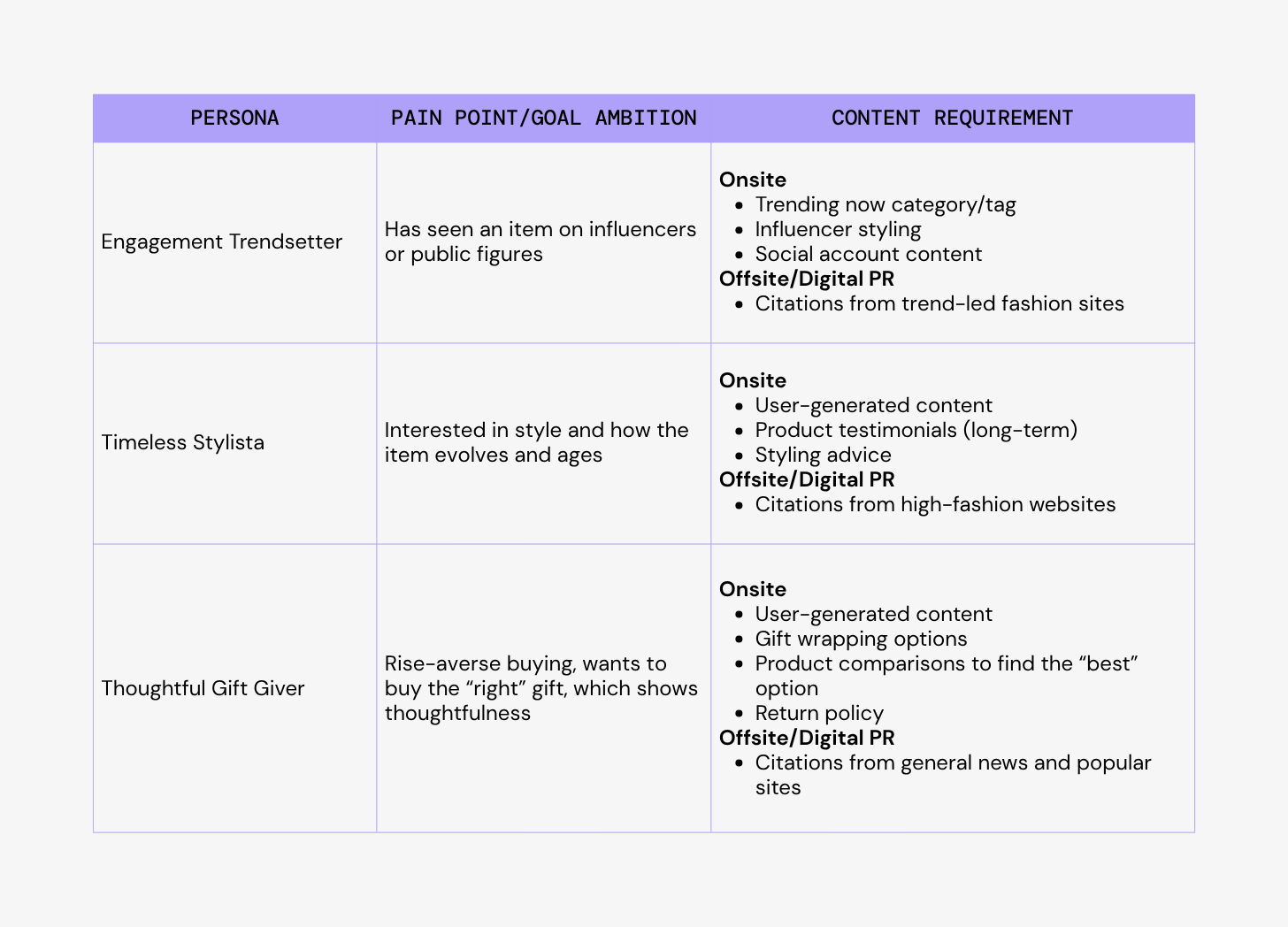
These content requirements may sometimes overlap; for example, both the timeless stylista and thoughtful gift giver would like to see customer user-generated content as social proof before purchasing.
However, content recommendations may also sometimes contradict one another. The Engaged Trendsetter does not want to see user-generated content, as they want to be first-movers within the trend.
How Can You Predict What Your Customer Will Search?
The other side of the story is - what information is AI looking for when customers search? What information is relevant to this page/topic? And this is where a query fan out can help us.
AI search engines don’t interpret queries as single keywords. Instead, they break questions into clusters of related sub-questions, often called query fan-outs. A query fan out takes a topic and breaks it down into related sub-topics or queries.
Using query fan-out mapping to key page types, we can then get an understanding of the type of follow-up questions AI may be looking to answer based on a given topic.
By understanding what AI is looking for, this can then be cross-referenced with the information you already have on a given page to see where your page performs well and where it lacks information that AI may be looking for.
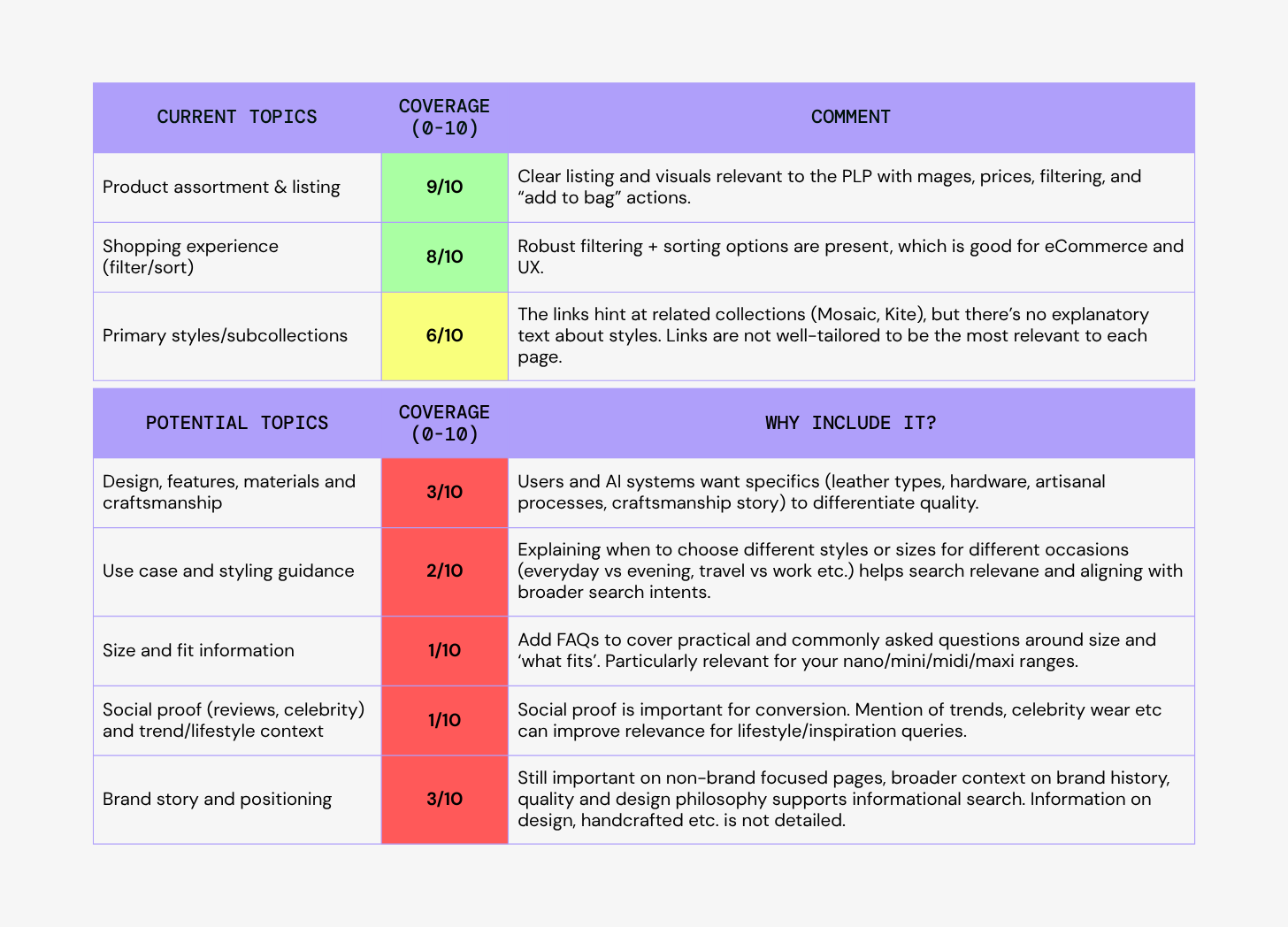
Cross-Referencing Personas Situational Search with Query Fan Out Mapping
By then cross-referencing the type of information your customers want, with the information your pages are missing, you can find both relevant and useful content to add to a page, which benefits your customers, traditional search, and AI search.
Signposting Attributes
A common question we get asked is, since all situational searches are so unique, how can we target this across our site?
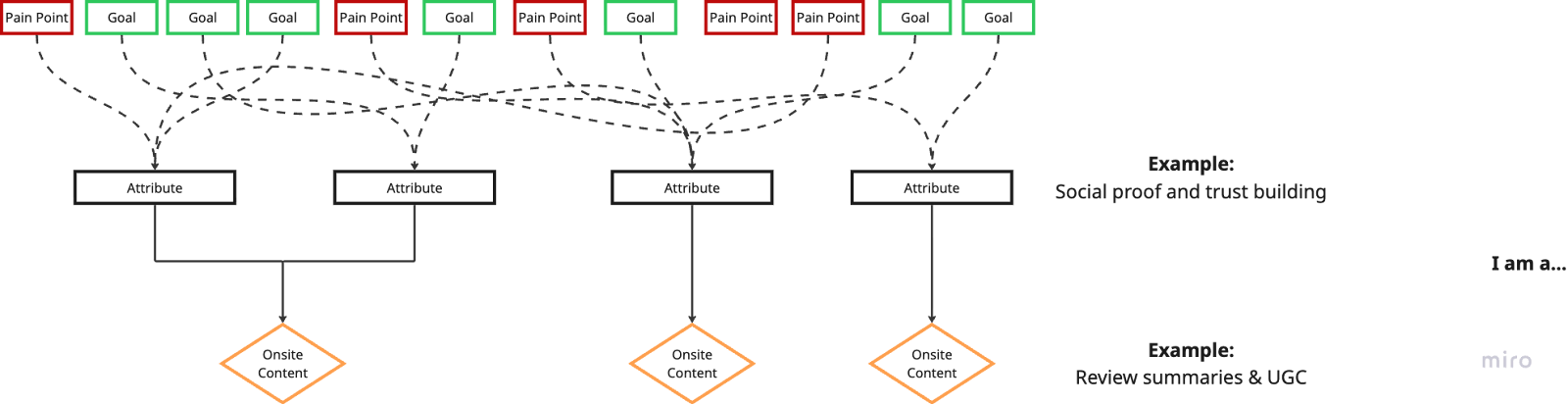
We’ll never be able to target every aspect of every situational search. However, using our key customer personas, we can signpost the key attributes of searches onsite. For example:
“I am a 31 year old man looking for rugby boots that I can wear on a muddy pitch. I play outside centre and want them to protect my feet. I want them to be flashy and last at least a couple of seasons.”
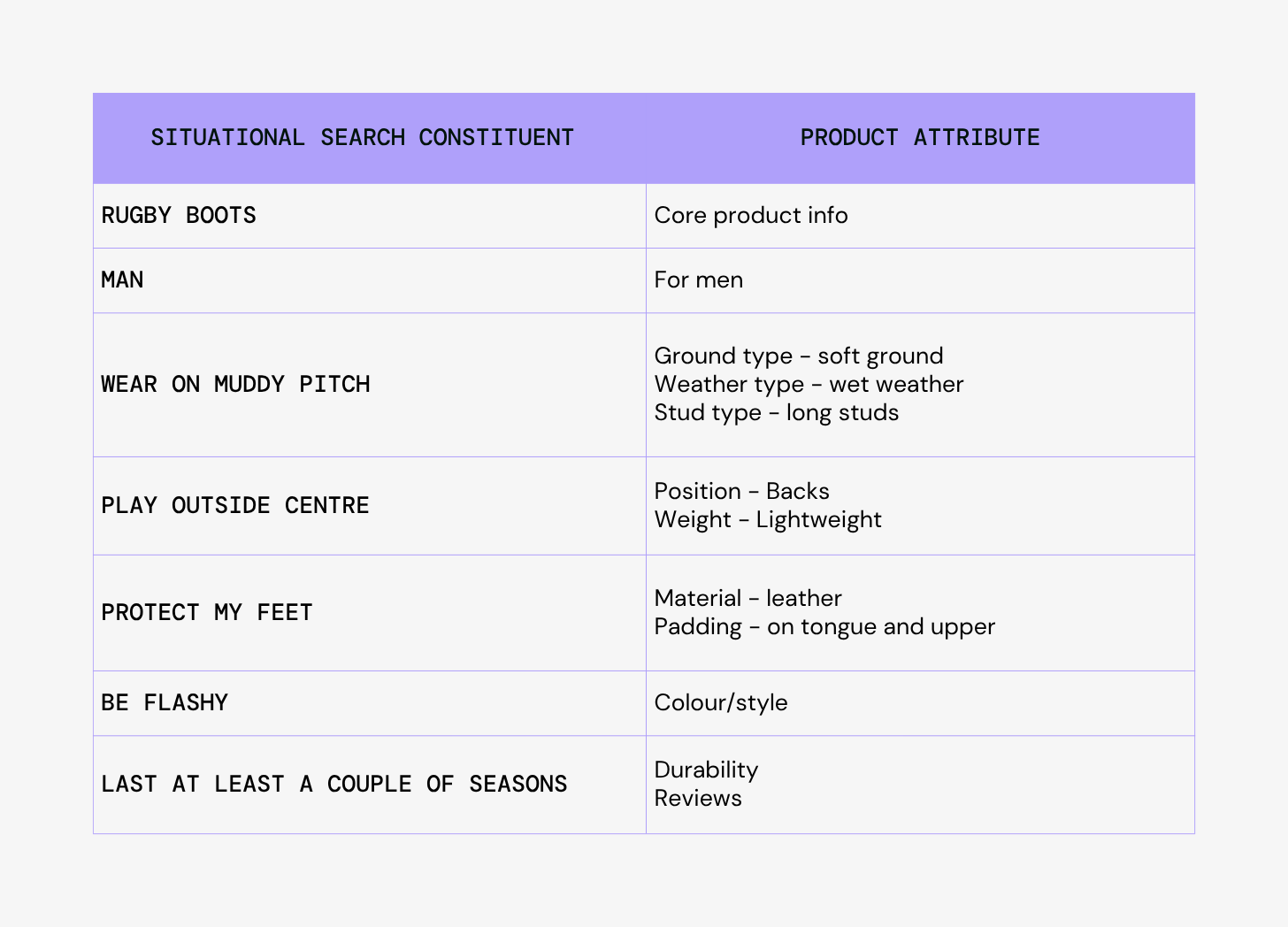
In this sense, a single situational search can be broken into its constituent parts, which can then be used as guidance for the types of info/attributes to be used across a variety of product pages, even if they sell very different products.
The “best for” product attribute
Previously, almost all products across an eCommerce site were presented as the best option for any customer. By defining who a product was best suited for, the implication was that it also must not be good for another customer, so this was avoided entirely.
With this new wave of situational search, with customers actively and specifically describing what they want, and don’t want, it helps to signpost when to use (or even not use) a particular product.
This is best suited when you have enough products to match the different needs of many customers. Counter-intuitively, by defining who a product is NOT for, you also may have higher customer satisfaction since they can compare and contrast what is best for their own needs.
The Challenges
Scalability
The biggest challenge with optimising for situational search is the scalability of changes. The content needs to be far more in-depth and across far more pages (1000s of PDPs vs 10s of categories). This represents a big challenge for many eCom sites.
Some AI tools, such as emfas or Ocula, can help to scale this across PDPs, whilst creating content that is in line with your brand and original - however, this should be approached with due caution. We’ve had success leveraging AI to create content of various forms, but it’s essential to avoid being generic.
Search Has Changed — Your Strategy Needs to Catch Up
The shift from keyword to situational search isn’t coming; it’s already here. The good news is that the foundation you need probably already exists in your business: your customer personas. By mapping who your customers are, what situations drive them to search, and what attributes matter most to them, you can build content that AI search engines want to surface and customers actually want to find.
The brands that win won’t be the ones who optimise for every possible query. They’ll be the ones who know their customer well enough to meet them in the exact moment they’re ready to buy.
Want to see how your PDPs perform against situational search? We offer a free AI visibility audit for eCommerce brands. Email dan@thisisnovos.com to claim yours or get in touch via our website.
 | A guest post by
|
Strong point on personas becoming central to SEO again. It feels like CRM thinking is merging with search strategy.