9 AI Search 2026 eCom Predictions: The Year of Connective Commerce?
Agentic commerce, top of funnel ads, the power of an ecosystem.

At the start of 2025 on LinkedIn (and in subsequent discussions with clients and partners), the central question was: Has AI finally killed SEO?
If you’ve been reading this Substack throughout 2025, you’d know by now that GEO/AEO is very much an SEO responsibility and area of ownership. You may think, “It was just LinkedIn chatter,” but you’d be surprised how many highly respectable people still use the platform for news and education.
Towards the end of 2024, an interim CMO we’ve worked with for nearly five years told me: “I’m telling my clients not to invest in SEO anymore because Google won’t be here in three years.”
Two years later, here we are. It doesn’t look like Google is going bust in the next 12 months; in fact, it is arguably stronger than ever, which is the first prediction we’re kicking off with for 2026.
Google’s Dominance Shows
2024 was the year of Bard and the “Google is dead” narrative. Critics claimed they couldn’t innovate. However, in 2025, Gemini continued to grow from strength to strength, resulting in a major new model release at the end of the year.
The impact:
Increased Gemini app downloads to take the number 1 download spot.
A shift in GPT’s priorities, the “code red” by Altman to improve GPT quality.
Potentially… a change in brand perception?
It further illustrated the juggernaut GPT is up against.
While GPT has often held the upper hand in model quality, we predict that in 2026, Google’s ecosystem will play a much larger role.
Google owns:
The Search Engine (Google)
The AI (Gemini)
The Browser (Chrome)
The Operating System (Android)
Why does this matter? Over 50% of searches happen on mobile. If you have an Android device, Gemini is embedded into the operating system. It isn’t a designated app you have to navigate to; it is an “always-on” assistant.
This is interesting because it can:
Read your screen.
Take direct actions.
Why should eCom brands care? Imagine saying, “Look at my basket. What am I missing, and are there other brands offering similar products for less?” Gemini reads the screen, provides four options, and outlines each brand’s USP. You then say, “Open brands 1, 3, and 4 in Chrome,” and Gemini executes, opening each homepage in your Chrome app. (p.s. Good luck tracking this user journey!)
This integration of AI Search, Browser, and OS is a game-changer. The above is a real example I did over the Christmas holidays, which reduced my basket cost by over 60%.
This is a basic example; imagine what will be possible in the next 12–24 months.
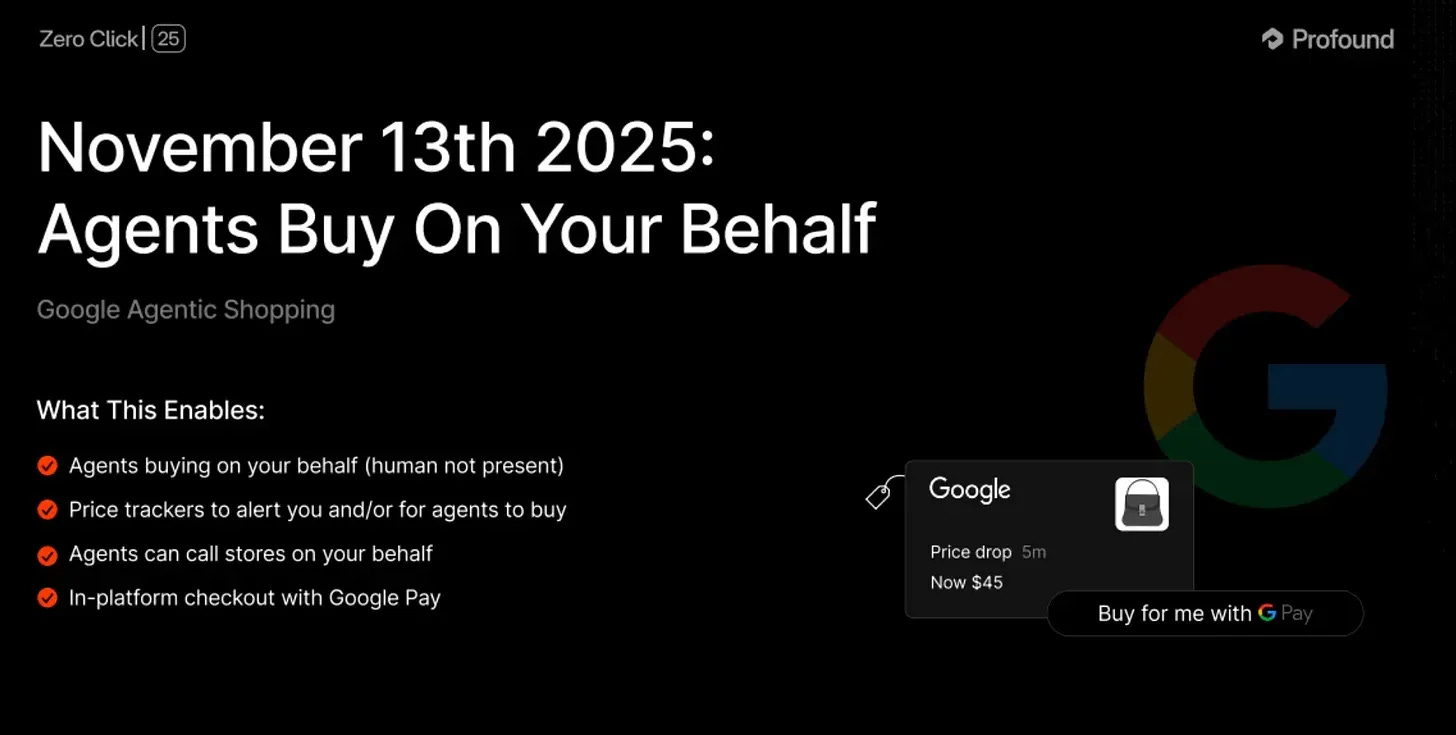
The industry's longer-term prediction is that it will shift toward “agents buying on your behalf,” referred to as ‘Agentic Commerce, ’ though we don’t expect it to take off in 2026 (see more below).
So two predictions here:
Attribution of these models remains impossible; referral traffic is only a fraction of the benefit
2026 is the year for Google AI - AI mode will become more prominent in the UK, reinforced by Shopify's recent announcement of a direct integration with AI Mode.
Blue-Sky Thinking: Will GPT Survive?
A few of our clients are now asking: Will GPT survive? It has allowed Claude to move in on “productivity” tasks, and it seems to have lost the first-mover advantage to Google in terms of the actual model. Furthermore, it still isn’t fully monetised.
Meanwhile, Apple is lagging in AI. The FT predicts Tim Cook could leave Apple in 2026, why wouldn’t Apple buy OpenAI? They would instantly gain the ecosystem needed to compete: AI Search + Browser + Operating System. While this isn’t going to happen, it makes for a compelling “what if.”
Agentic Commerce: The Rise of Feeds
This was one of our 2025 predictions. While the requirements for GPT shopping feeds have been announced, the ability to submit a feed is not yet available. We expect them to land in 2026. These feeds will be more dynamic, allowing daily optimisations to influence results.
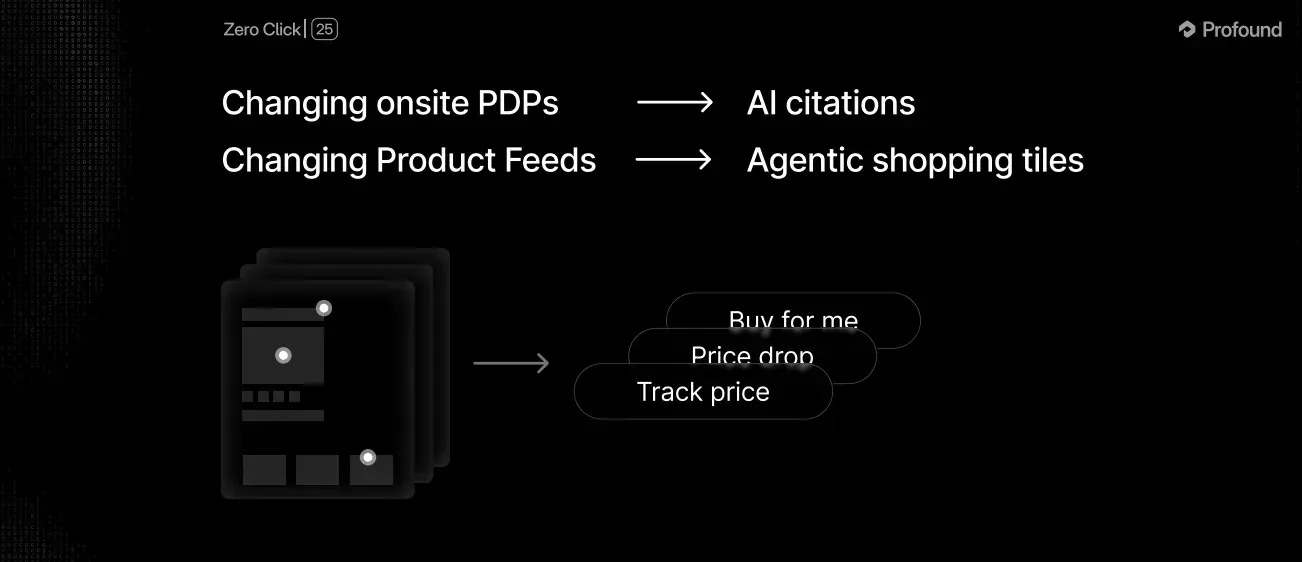
Throughout 2025, our focus was on the “discovery” aspect of AI Search, optimising PDPs and detailed, persona- and need-based content.
In 2026, GPT will finally introduce more commercial capabilities, enabling trackable sessions and revenue in tools like GA4 and Shopify.
As of January 2026, Shopify and Google have already announced their connection through UCP - “the common language between platforms, businesses and agents”, more here: https://ucp.dev/
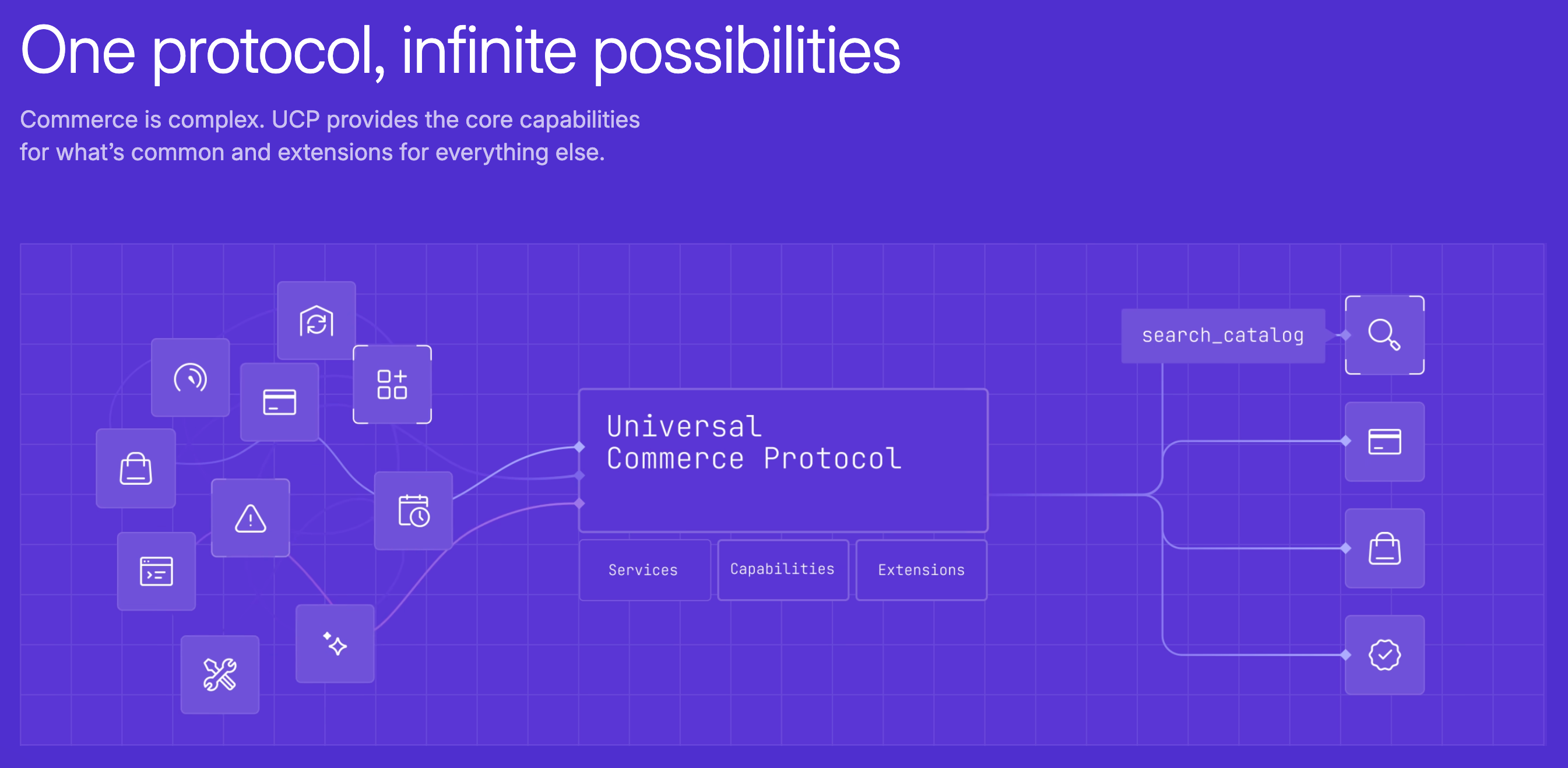
You can see how this will eventually lead to the Agentic commerce point referenced previously.
There are two parts here:
The ability to submit feeds and get the commercial shopping tiles in GPT, which will have a strong impact
The ability of technology to integrate will take off in 2026; however, we think the actual buyer behaviour of searchers to actually allow an agent to buy on their behalf is going to take a while to catch on
Stripe is expected to announce its own version of agentic checkouts in early 2026, which is good news for non-Shopify brands.
GPT Ads: A No-Show?
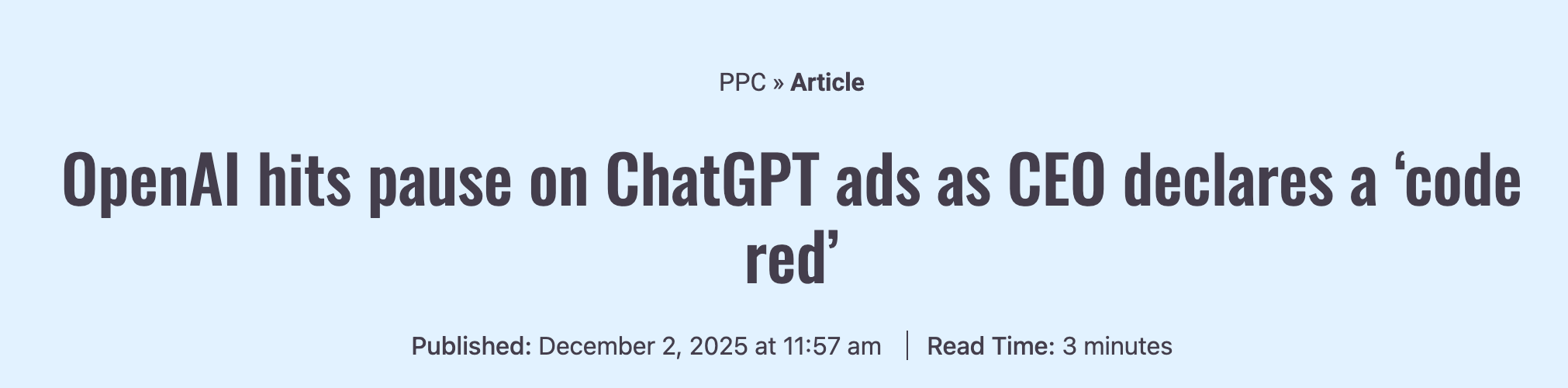
This could go two ways. Gemini took GPT by surprise with its latest model, forcing a shift in priorities or a “code red”, as Altman called it. Consequently, OpenAI must choose:
Monetise immediately to generate income and compete.
Delay ads to focus on the user experience before “damaging” results with sponsored content.
All talk and headlines point to option 2, but the astronomical cash burn makes you think: Can they really go another 12 months without better monetisation?
More Ads at the Top of the Funnel
Google ‘beta-tested’ AI mode towards the end of 2025 - our clients saw mixed results.
Despite the results, it’s a clear indication of where Google is going with ad targeting. I always struggled to see how they’d change targeting to be able to monetise the hyper long tail searches of AI - the answer is your website content.
We discussed the topic of the influence GEO/AEO content could have on your ad targeting in this post, here.
In December, we also collaborated on a webinar on the same topic with our friends at Vervaunt, Pion333rs and Glara. We’ll share this with you next week.
Monetising the top of the funnel
If this approach works, it could be massive for Google. Historically, 80/90% of search clicks went to SEO.
Google has always struggled to monetise this part of search - if they can crack it, that’s 8/9x more opportunity for monetisation. Granted, CPCs will be lower due to fewer commercial and competitive queries, but volume will be astronomical.
Zero-Click Search Continues
We predicted this last year, and anyone in SEO knows CTR has been declining for years. However, recent data from SparkToro shows that CTR actually increased in the last two quarters of 2025. Google has already stated it expects this trend to continue.
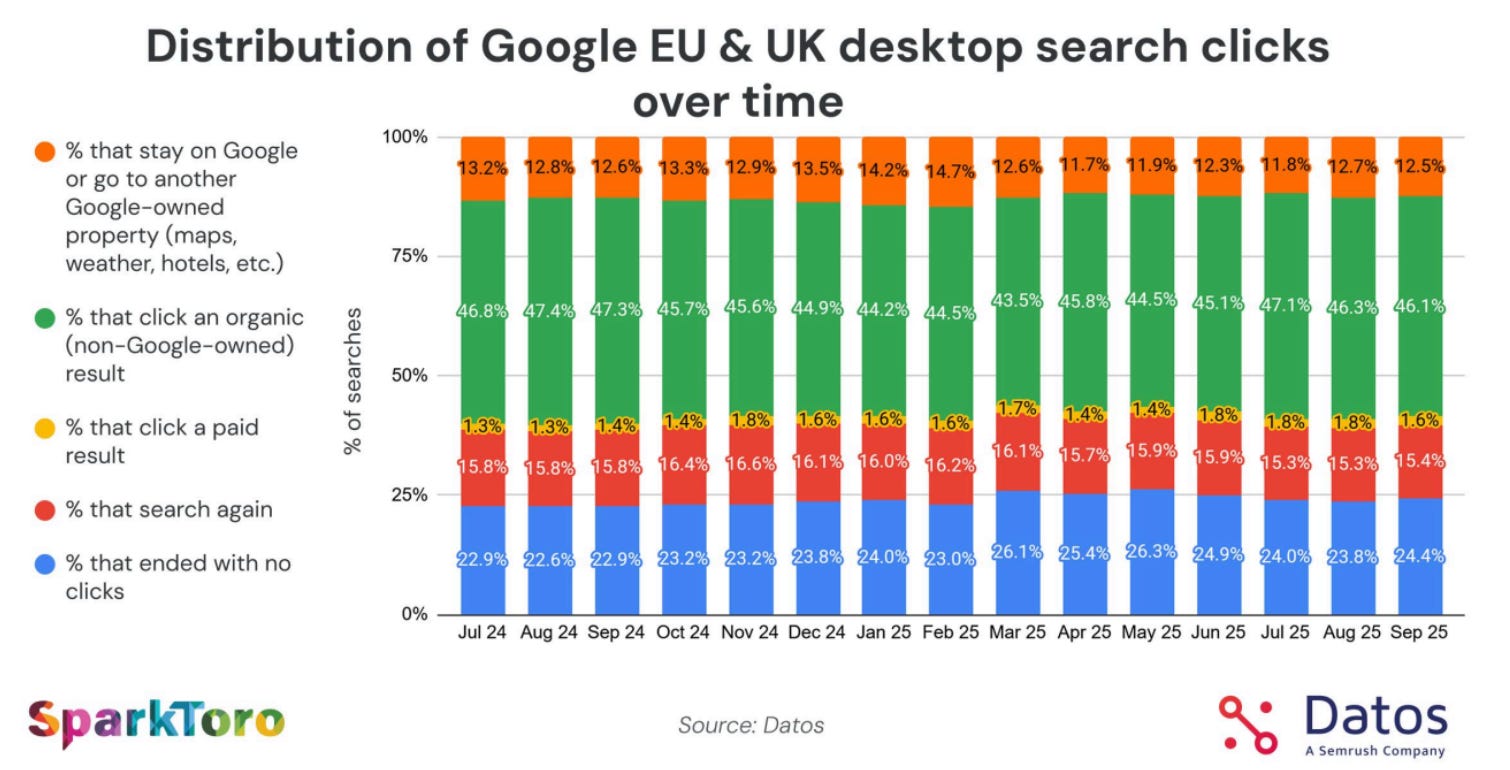
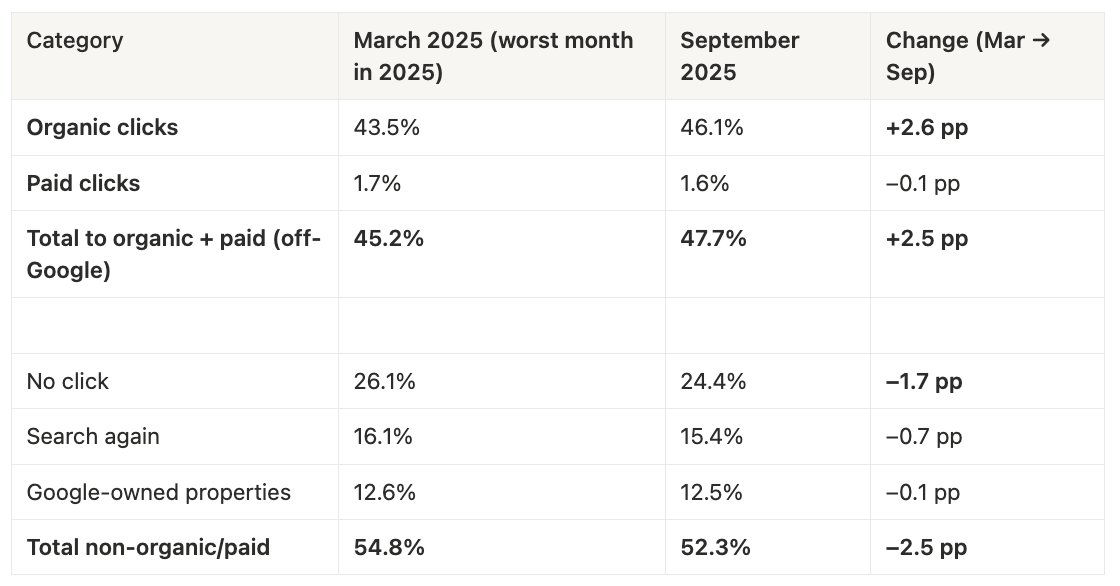
By September 2025, roughly half of the lost clicks came back. However, if you’ve been in SEO as long as I have, you know this is a decade-long strategy. In 2015, Google released Featured Snippets, pulling comparison results directly into the SERP (and tanking Expedia’s share price in the process). Google’s goal for over 10 years has been to move from a referral engine to an experience engine.
Even if the numbers changed unexpectedly toward the end of 2025, there’s a broader trend at play, and we expect CTR to continue to decline.
The Data Drought
We do not expect more AI-specific performance data from Google or GPT this year. We want AI results segmented in GSC, and we want a “GSC equivalent” for GPT - but for now, we can only dream. As a result, the GEO ranking tools like Profound and Glara will be an essential tool in an SEO’s arsenal.
The previously referenced agentic commerce + feeds will support the commercial aspect of AI search. Using the same data reference previously, if 80/90% of Google's traditional search is discovery, overly focusing on the commercial last click means you are missing out on the discovery aspect of AI search.
Why “GEO/AEO” Terms Are Here to Stay
At the end of 2024, we predicted these terms would disappear. We were wrong. While people now know it falls under the SEO umbrella, we still need a term to differentiate “Traditional SEO” from “AI Search” activity.
The SEO industry actively rebels against the term “GEO,” but broader marketers and mainstream publications continue to use it. My advice? Embrace the term. This is the most attention SEO has received in years. It would be classic SEOs to miss this opportunity by being pedantic about terminology.
2026 wish: We all just settle on one term and stick with that.
The Strain on Publishers
The publisher model has been hit hard by “zero-click” search. Referral traffic from Google has been their lifeblood for years - but fewer page visits mean fewer opportunities for monetisation, creating fresh challenges for media outlets hoping to sustain growth.
This matters for SEO and eCom brands because we rely on these publications for the links and coverage that drive authority.
Current defence strategies include:
Selling content: Direct annual agreements with AI models.
Owned Audiences: Shifting toward app-based and video content.
Gated Content: Using apps to collect first-party data (emails), which is more valuable than traditional display ads.
Video content remains a stronghold because it is too complex for AI models to fully “own” yet. Models might cite a clip, but the user still needs to visit the site for the full context.
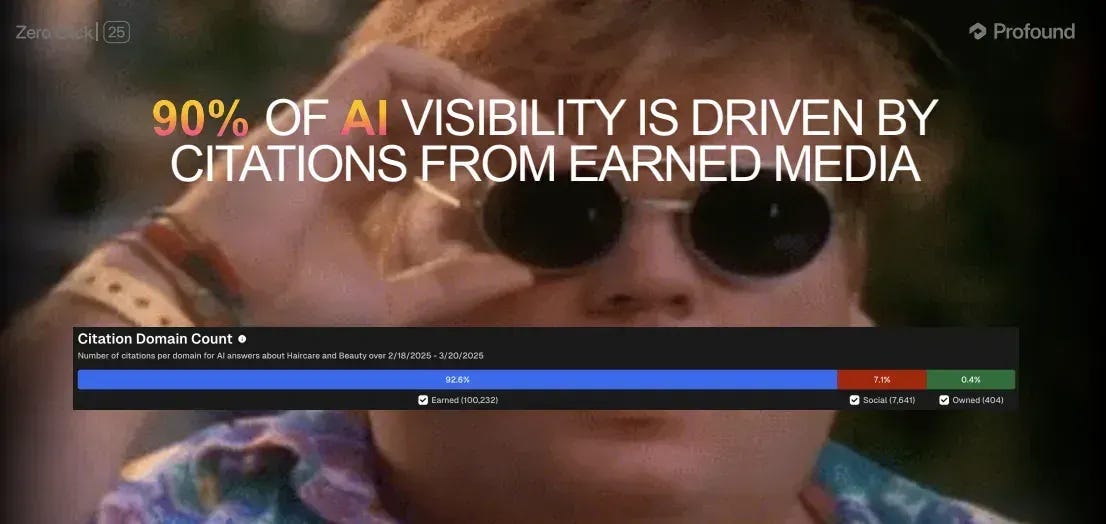
Why you should care? Over 90% of AI search results are influenced by Earned Media, not your owned website.
The Great PDP Overhaul of 2026
In 2025, e-commerce brands were busy educating themselves and freeing up resources about AI Search. Now that the planning is done, we expect a wave of implementation. 2026 will be the year of the AI-optimised Product Detail Page (PDP).
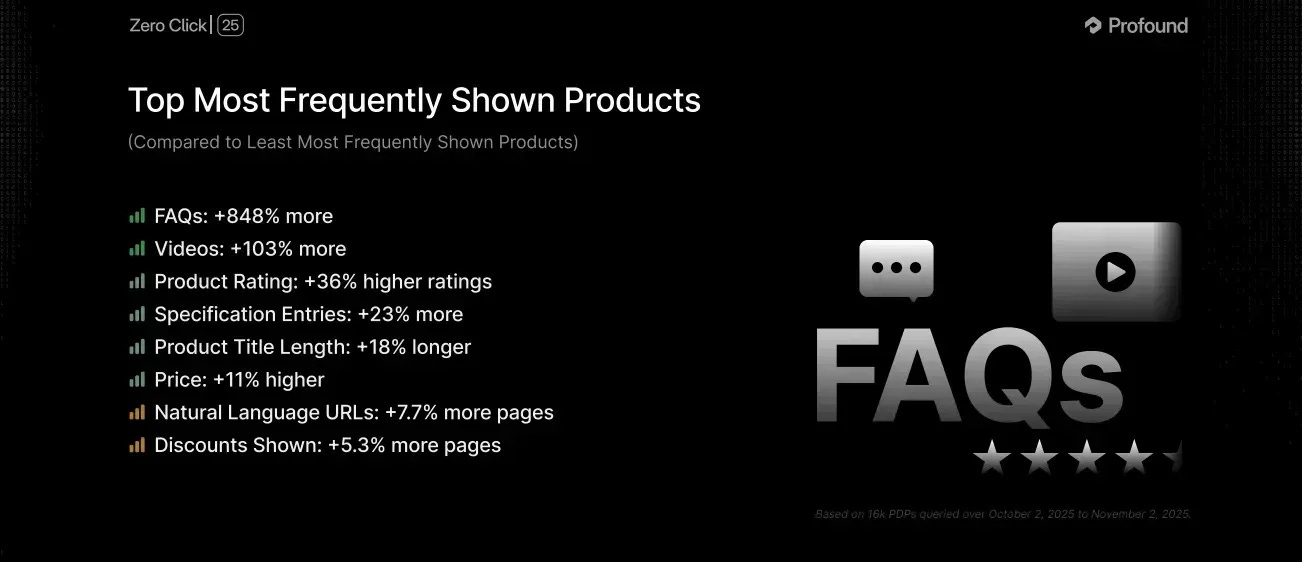
If you want inspiration, read our previous post by Laura: https://ecommerce.thisisnovos.com/p/real-life-examples-of-ai-optimised.
Conclusion: Stop Waiting for the Dust to Settle
As we move into 2026, our message to brands and marketers is simple: stop waiting for the dust to settle.
Whether you call it SEO, GEO, or AEO, the objective is the same: ensuring your brand is the most authoritative, visible, and shoppable answer across an increasingly complex search ecosystem.
We often hear, “It’s only a fraction of our traffic,” or “You can’t measure the ROI yet.” That framing misses the point. AI Search is not just a traffic channel. It is rapidly becoming a brand-discovery channel, and the brands that win there will compound their advantage well before reporting feels comfortable.
We’re also asked about the split between SEO and AEO. In reality, there is no split. Everything we do for AI Search strengthens traditional SEO foundations.
The only time SEO becomes the sole focus is when a brand’s technical baseline is so weak that it prevents discovery.
The “Great PDP Overhaul” is already underway, and the gap between brands that act and those that wait will only widen. You’re essentially choosing between two camps:
Camp 1
Waiting for platforms to explain the rules.
Prioritising dashboards over strategic direction.
Delaying investment until measurement feels familiar.
Avoiding difficult conversations about declining search visibility.
Camp 2
Accepting imperfect data as the new normal.
Investing in fundamentals: authority, relevance, and high-quality content for real brand personas.
Prioritising model visibility, even when it can’t be fully measured.
Educating stakeholders early and leading through uncomfortable change.
The brands that win won’t be the ones with perfect data. They’ll be the ones who moved first.
You already know which camp wins. Have a great 2026.