

🤔 Want Better Ad performance next year? Start With Better SEO 🤔
How situational, persona-driven content (GEO/AEO) becomes the instruction manual for Google’s AI-powered ads.

Now is when eCommerce brands start thinking about 2026. As part of your New Year’s resolutions, how about beginning to see your SEO investment and paid search investment as “Search investment”? Let me explain.
💡 The Core Shift
All eCommerce brands run Google Ads, but the game is fundamentally changing.
When Google launched AI Max for Search, we got a glimpse into the future of how Google sees its advertising targeting for AI mode and beyond. Your keywords are no longer the primary instruction manual for Google. Your website content is.
AI Max is not just an ad setting; it is a mirror of your website's quality. If your SEO and content strategy targets specific, long-tail user needs (AEO/GEO), AI Max can be a powerful discovery engine. If your content is generic, your ad spend will be too.
Keyword-less technology
AI Max, PMax, and Dynamic Search Ads are all part of Google’s “keywordless technology.” This means your product descriptions, blog posts, and landing pages now serve as direct targeting parameters for your paid ads. It merges the worlds of SEO and Paid Search - your Google paid media now treats your website’s content as its key instruction manual for targeting. (I know, it’s painful for an SEO to write this.)
AI max not working? Maybe it’s your website.
There have been critics of AI Max’s performance due to poor targeting, but could this be because e-commerce websites aren’t GEO/AEO-optimised, as they don’t invest enough in improving their content targeting? 🤔
Google’s case study cites L’Oréal’s example of how it used AI Max to capture new queries it hadn’t previously targeted, such as “what is the best cream for facial dark spots?”
This is a need-based query, not a product-name query. This is the modern world of SEO (GEO/AEO/AI SEO), which we’ve written about many times on this substack. Extract below from the case study:
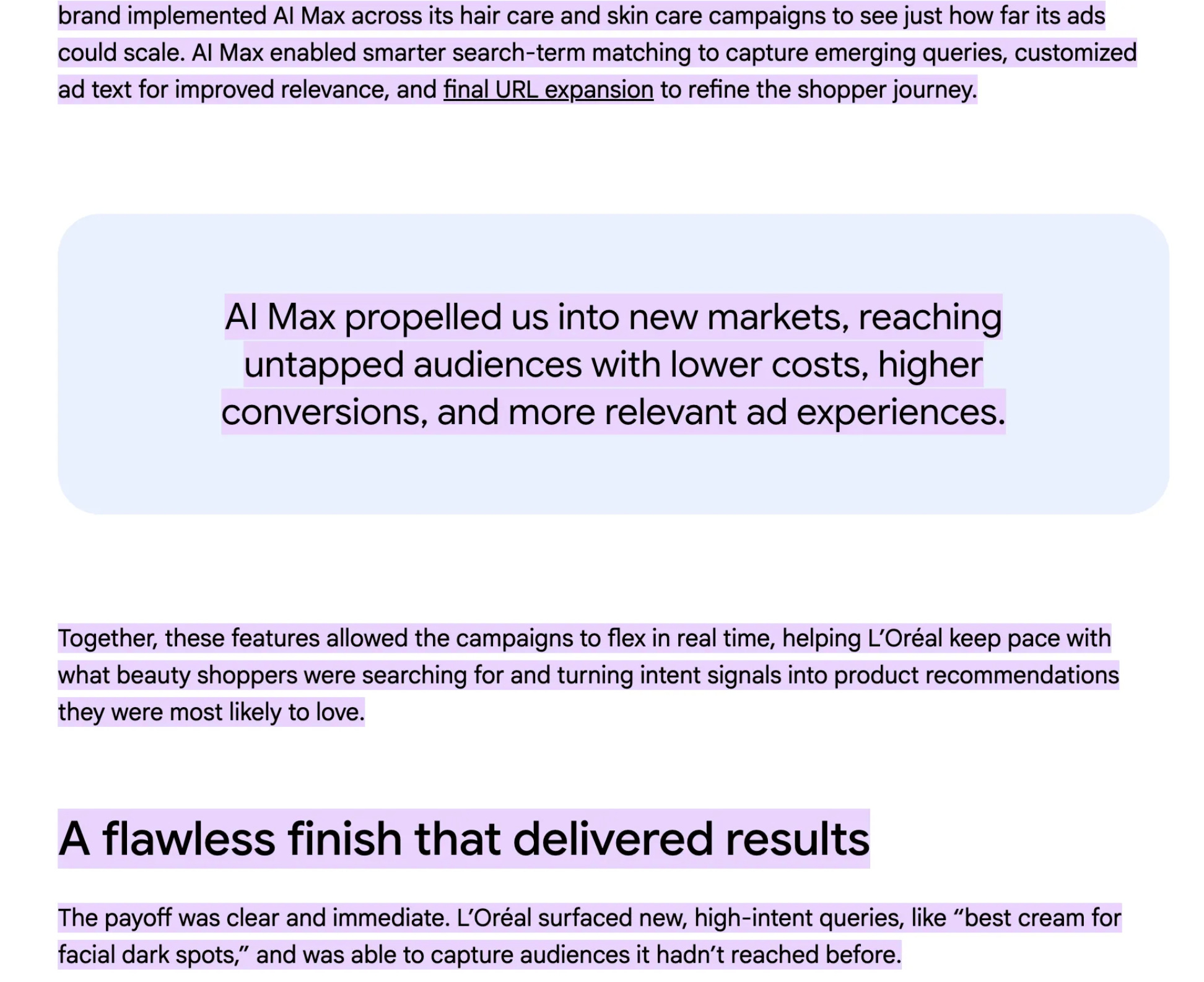
https://business.google.com/uk/think/ai-excellence/loreal-ai-max-search-marketing-strategy/
Google’s done this before
For context, I’m not a paid search expert, but I’m very interested in Google’s relationship with SEOs and their broader intentions.
They have a track record of this. Back in 2015, Google wanted a faster internet for its users - what did Google do?
It introduced the Core Web Vitals and said it's now a big ranking factor (it wasn’t big) - suddenly, every SEO was pushing to speed up websites to hit this ranking factor and ultimately achieve Google’s broader goal.
I believe this is what they are doing again; it’s impossible to target the hyper-personalised, ultra-long-tail searches of Gen AI, so why not get SEOs to do the work for them?
SEOs define the content strategy, leveraging the brand's personas and the on-site changes to be made. The ads algorithm takes this, says thank you very much, and suddenly you see Google ads appearing for super long-tail, commercially led terms that would have previously gone to SEO - Google makes more money. Genius really isn’t it … fair play.
How AI Search can help Performance Max (PMax)
Performance Max is the “older sibling” to AI Max and part of Google’s “AI Power Pack” (alongside AI Max and Demand Gen). It relies heavily on your website’s content to find customers across YouTube, Display, Search, Discover, Gmail, and Maps.
Asset Generation: PMax uses your landing pages to automatically generate headlines and descriptions, similar to AI Max’s “Text Customisation”. If your content is optimised for specific personas (e.g., addressing specific pain points rather than just listing features), the AI can generate more persuasive, human-sounding ad copy.
Audience Signals: PMax uses your content to interpret who should see your ads. By using GEO/AEO strategies - writing content that answers complex, conversational queries, you help PMax’s algorithms match your ads to users exhibiting those specific high-intent behaviours, even if you haven’t explicitly targeted them.
What is AI Max (and Why Should eCommerce Care)?
Unlike Performance Max (PMax), which is a standalone campaign type, AI Max is a layer of automation you toggle on within your existing Search campaigns.
It uses Google’s AI to find customers using three specific mechanisms:
Search Term Matching: Using “keywordless technology” to find queries that are semantically related to your business.
Final URL Expansion: Dynamic Search Ads (DSA) technology that swaps your landing page if the AI finds a better match on your site.
Text Customisation: Generative AI that writes headlines in real-time based on your landing page copy.
⚠️ The “Black Box” Warning: While Google claims AI Max drives 14% more conversions, independent tests from over 250 retailers found it delivered conversions at a 35% lower ROAS compared to traditional match types.
🤔As referenced previously, maybe this low ROAS is because most websites aren’t investing enough in this new world of intent targeting?
GEO content = Better ad targeting.
Because AI Max relies on Large Language Models (LLMs) to understand user intent, it doesn’t just look for “keywords” - it understands needs.
This is where GEO/AEO/ AI SEO comes in.
If your eCommerce site is optimised only for head terms (e.g., “Running Shoes”), AI Max has minimal context to work with. It might match you to broad, low-intent traffic.
Here are examples of why you must optimise for ultra-long-tail, need-based searches.
1. Optimise for “Problem-Solution” Syntax
AI Max’s Search Term Matching analyses your landing page to decide “when and to whom an ad should appear.”
Old SEO approach: Optimise a Product Detail Page (PDP) for “Waterproof Hiking Boots.”
AI Max / GEO approach: Update the PDP description to answer who this is for and why explicitly. Eg Adding copy like: “Ideal for hikers with flat feet needing ankle support in muddy terrains.”
Why this works: When a user searches “best boots for muddy trails flat feet,” AI Max sees the semantic match on your page and serves the ad - even if you didn’t bid on “flat feet” keywords.
The SEO/GEO Angle: If you optimise a page for specific long-tail searches (e.g., “ergonomic standing desk for small apartments” vs. just “desks”), you provide the AI with more precise semantic boundaries. This helps the “keywordless technology” identify relevant, high-intent traffic rather than wasting budget on “remotely similar” or irrelevant queries.
The L’Oréal example referenced at the start used AI Max to capture queries they hadn’t thought to target, such as “what is the best cream for facial dark spots?” This is a need-based query, not a product-name query.
We’ve written about this in this ‘situational search’ post > https://ecommerce.thisisnovos.com/p/situational-search-how-to-get-your?r=2qo9mq
2. Findability and understanding of content
If you enable AI Max, Final URL Expansion is on by default. This means Google can ignore your specified ad URL and direct users to any page on your site it deems relevant.
A messy site structure sends traffic to irrelevant pages. A well-organised site turns this into an advantage.
The Fix: Create distinct landing pages for specific attributes—for example, separate collections for “Sulfate-Free Shampoo” and “Colour-Safe Shampoo.”
The Benefit: When users search for niche attributes, AI Max can dynamically route them to the exact collection page instead of a generic homepage, boosting conversion rates.
The SEO Effect: If your site architecture is SEO-friendly - meaning you have distinct, well-optimised pages for specific sub-topics or products - AI Max has a better “menu” of options to choose from. It can direct a user searching for a particular long-tail niche to the exact page that answers that need, rather than a generic home page, potentially improving conversion rates.
The example here is basic, but imagine if you had a large eCommerce site selling multiple products across multiple brands - this need becomes even more critical for fundamental findability and understanding.
3. Targeted content feeds the ad copy
AI Max uses Generative AI to write headlines in real-time based on your landing page content.
Garbage In: If your product page says “High quality, best price, buy now,” your AI-generated ads will look generic and spammy.
Gold In: If your product page highlights unique value propositions like “Sustainably sourced cotton”, “water resistant to 300m,” or “ideal for marathon pros”, the AI will pull these into the ad copy, making your ads more relevant to specific queries.
The SEO Angle: The AI generates ads using the text it finds on your page. If your on-page content is rich, persuasive, and full of core attributes, the AI-generated headlines will likely be more relevant and compelling. Conversely, if your landing page is vague, the AI may generate generic ads.
This is the second E in our SEED framework, which is all about enhanced PDPs, which we discuss and give an example of in this post > https://ecommerce.thisisnovos.com/p/a-cmos-guide-to-geoaeo
AI Max can still go mad.
Even if AI Max is still a bit aggressive or goes too broad with good GEO content, this is a clear signal from Google about how ad targeting will work in the future.
Google needs to monetise AI mode and AIOs; 90% of Search clicks went to SEO - the long tail, which Google’s never been able to monetise. AI mode will make this even harder unless it leverages the website's content and long-tail targeting, which is SEO’s role to build and define.
Summary
The key consideration here is that better GEO/AEO targeting will impact your paid ad performance.
How should paid and organic teams work together
I believe that, as paid search has become less tactical and more strategic, paid search teams should bid where SEO isn’t and understand how their spend affects the business as a whole. SEOs should focus on content strategy to position the website toward customer needs, embrace situational search, and work closely with brand teams to align messaging and target relevant offsite coverage. This way, both channels can help each other:
Paid Search helps avoid cannibalising SEO by constantly reviewing ad data vs. SEO performance, ensuring updated content is used to boost paid numbers without harming the wider business.
In return, SEOs help the paid team by making the website better targeted towards need-based searches and a much more content strategy-led approach.
For marketing leaders overseeing the entire marketing mix and budget, this post is intended to show that when you invest in “GEO or AI Search,” you aren’t just investing in SEO- you’re investing in better content targeting that addresses your customer personas’ needs and pain points. This fuels all marketing channels and yes… even Google Ads.
Sources
https://business.google.com/uk/think/ai-excellence/loreal-ai-max-search-marketing-strategy/
https://ppc.land/independent-tests-show-ai-max-underperforms-traditional-match-types/
https://searchengineland.com/ai-max-for-search-everything-you-need-to-know-462923
https://support.google.com/google-ads/answer/15910187?hl=en
https://ppc.land/independent-tests-show-ai-max-underperforms-traditional-match-types/
GEO is the new SEO